


This is Spitfire, a style of head-to-head debates between The Accolade’s two Opinion editors. Elise is red. Kyuwon is purple.
PREVIOUSLY ON SPITFIRE: The two Opinion editors went head-to-head about whether it’s better to shop at thrift stores or retail stores. Elise, the winner, argued that thrifting is the superior choice. Which editor will take the cake this time? One thing’s for sure: they’re both about to spit FIRE.
Here are the rules:
- No profanity.
- An editor attacked by the other will be given three sentences to respond.
- The readers will decide who wins through a poll at the end of the article.
- Once a rule is broken, the debate ends.
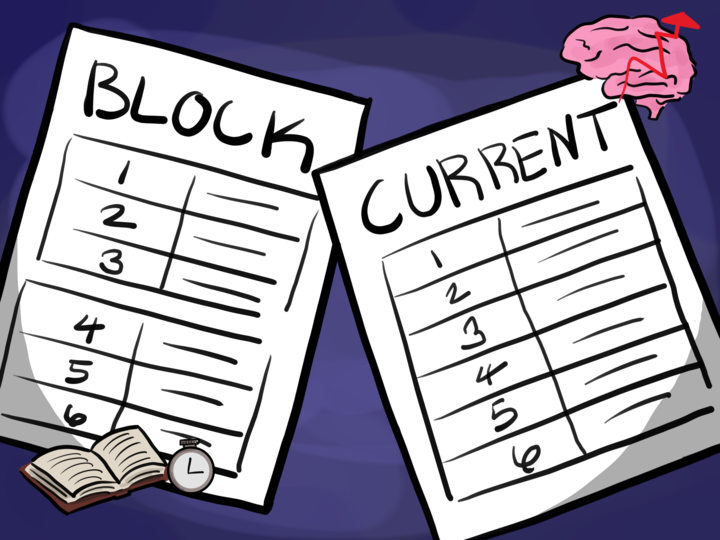
Imagine one day you go to English class, and then the next day, you don’t. A regular schedule undoubtedly remains more beneficial to the student body than a block schedule because longer class periods during a block schedule do not help with long-term memory, according to a National Library of Medicine article. Each period during the block schedule lasts for about two hours, and it doesn’t guarantee a better form of learning, as teachers can give simple lectures, making students lose concentration, as active learning isn’t present.
Kyuwon, don’t get me wrong, I see your point, but because block schedules have longer class periods, students and teachers both get a full day in between to review and prepare for the next lesson. This extra time allows students to process information at their own pace, which, according to The Decision Lab, can actually strengthen long-term memory. Instead of being rushed through daily classes, they can come back more prepared and focused.
Elise, a regular schedule in which students attend all their classes every day, helps with courses that require repeated practice and studying. Repetition is essential in language classes and math classes because it builds on long-term memory and strengthens knowledge, according to an essentialskills.com article. Also, during the two hours in class, students will lose focus due to their short attention span, causing them to easily forget information from the previous class time, according to a time.com article.
Yes, repetition is beneficial, but block scheduling gives students longer periods to dive deeper into labs, projects and discussions without being rushed. This extended time can improve understanding and allow teachers to use more interactive methods instead of surface-level lectures. Plus, even with block schedules, students still review material at home, so that consistent practice you were referring to is not lost.
Sometimes, absence is unavoidable, and during the block schedule, students will experience greater loss. Even in an hour-long class, when a student is absent for a lecture, they have to ask their teacher and peers to catch them up, but what a student misses during a one to two-hour class is a lot. So, it prevents students from moving on from the absence, but instead forces them to catch up, which disrupts learning even more.
In reality, block scheduling actually reduces the number of classes a student misses in a single day, making absences easier to manage. Instead of falling behind in six or seven classes, they would only need to catch up on three or four.
Because of the violation of rule No. 2, Spitfire ends by default. Who do you think is right? Click on Kyuwon’s or Elise’s picture to declare your winner.
Sorry, there was an error loading this poll.