


March Madness.
No, not the term referring to the men’s college basketball tournament, but instead, a “competition” of its own at Sunny Hills — one among seniors.
As college decisions slowly begin to reveal themselves in the spring and expectations of impending disappointment draw near, we, as seniors, look for any outlet to ease our nerves from the madness of not knowing what the academic future holds.
Actually, this kind of hunger for collegiate success is not only prevalent among seniors, but remains pervasive across all grade levels — posing a burning question: What is the allure of academic success?
ALL IN FOR AI
The mere desire to gain admission to a top school — an Ivy League school or a University of California [UC] campus, for example — sets off an unhealthy cycle in which eagerness for acceptance fuels the temptation to engage in academic dishonesty.
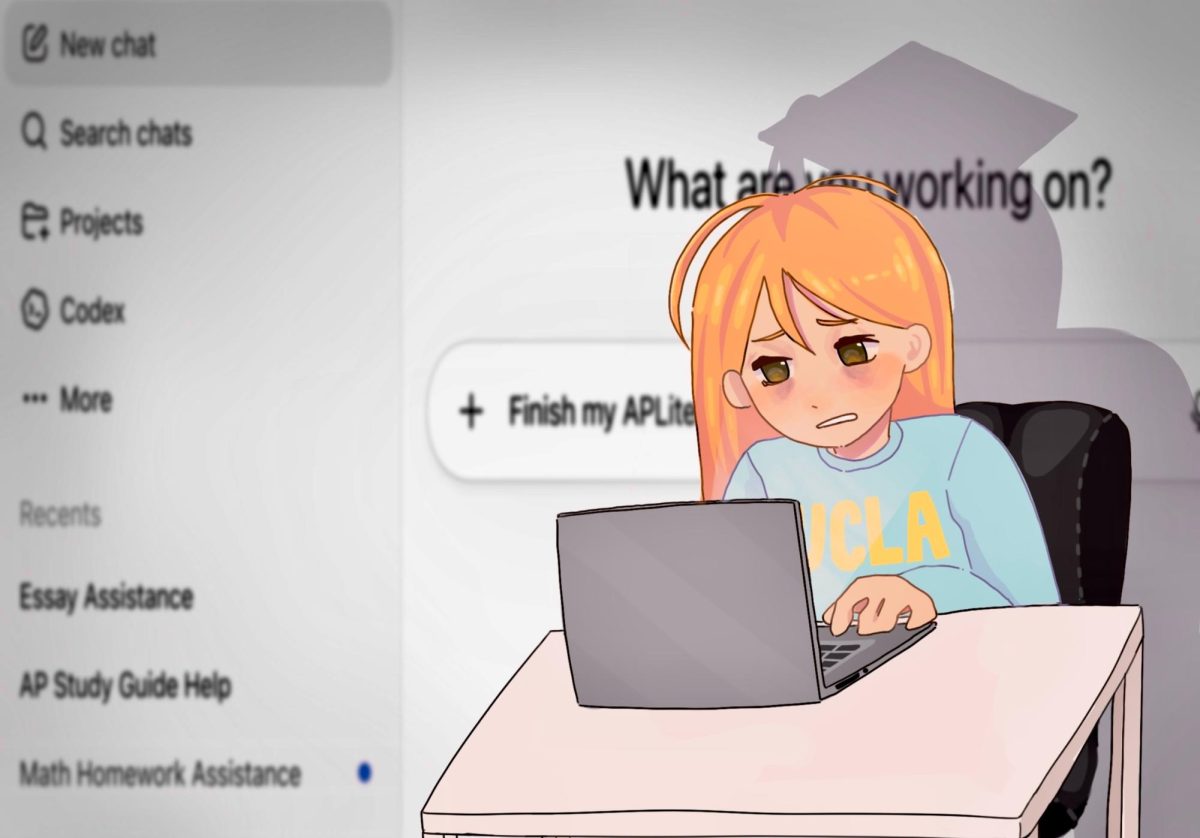
Inevitably, students begin to find comfort in the newest artificial intelligence [AI] platforms — like ChatGPT, Gemini AI and Gauth AI — to get the answers they need to ace a test, the words they need to construct an essay and the work they need to finish an assignment. What starts as a small “one-time thing” eventually leads to a relentless use.
Primarily, SH students have said they utilize these platforms to maintain their 4.0 GPAs, possess an unblemished transcript and become one step closer to their “dream school.”
“I use ChatGPT almost every day and sometimes even get pressured into using it for tests and essays because I see my peers doing the same thing,” an anonymous senior source said. “It just feels unfair to study for hours on a test when I know everyone’s going to cheat either way, so I just hop on the bandwagon.”
Furthermore, according to a June 2022 National Library of Medicine article, 58.1% of students stated academic projects are too tough to handle for them, leading to increased stress levels and eventually deteriorating mental health.
As students, when all we are constantly asked about on exam day is, “Hey, what did you get on that test?” by our overachieving peers, the seed of academic inferiority is planted and twistedly nurtured in our environment.
“The same way people look up to high achievers, they look down on low achievers,” senior Jacob Michales said.
Now, we do acknowledge that such instances may not occur pervasively throughout campus. However, in the Advanced Placement [AP] atmosphere we find ourselves in, this kind of pressure is not uncommon.
“I think especially with a lot of people taking advanced classes, there’s a lot of talk about academics,” senior Abigail Compton said. “And, especially being seniors with college and hearing other people’s acceptances, there is pressure, but that kind of just comes naturally.”
However, there are two sides to every coin; some are lucky enough not to experience this phenomenon at all and identify themselves as those who “set the curve.”
“I can see how being in a class with really smart people can affect it, but I feel like at the end of the day I’m always completely aware that I have the ability to control how much I study and how much work I put into school, so other people doing better than I am is really up to me,” senior Jaden Shim said.
DESPERATION IN DISGUISE
But this hyperfixation on a specific grade or a perfect transcript undoubtedly leads to unethical loopholes in the search for academic success, and even worse, catalyzes a phenomenon known to SH seniors as the academic “fear of missing out” [FOMO].
Specifically, we saw this occurrence during the 2026 college decision cycle among seniors when indulging in an unconventional academic loophole: portal astrology.
For those unfamiliar with this concept, portal astrology involves applicants discerning a particular clue — like a 10-digit ID or financial aid status — to determine whether or not they were admitted to the college, before the veritable decision letter is released.
Predominantly, seniors relied on this loophole to uncover decisions from UC Berkeley, UC Irvine and UC San Diego, serving as a perfect example of academic desperation and an unhealthy attempt at deciphering a truth — blatantly doing more harm than good.
Eventually, we will inevitably open our portals and view the true results — yet we still attempt to find solace through these discrepancies because the people around us yearn for a small glimmer of reassurance.
“If you somehow get [portal] astrology to work, it’s going to make you feel better,” senior Caleb Solis said. “And, when everyone’s around you talking about it, it’s going to intrigue you more, making you try it regardless.”
Although it may seem difficult, we as seniors implore the rest of the Class of 2026 to set a healthier precedent for future generations — one that strays away from academic FOMO, unethical AI use and portal astrologies all combined.
At the end of the day, though cliché, the way we view our high school experience influences our mental health; so, let’s make it a healthy one — both academically and mentally.