
It was first a novel.
Then, it was a musical.
Now, it is an award-winning film adaptation.
But this is not the end of the “Wicked” series, as its highly anticipated sequel, “Wicked: For Good,” was released in theaters on Friday, Nov. 21.
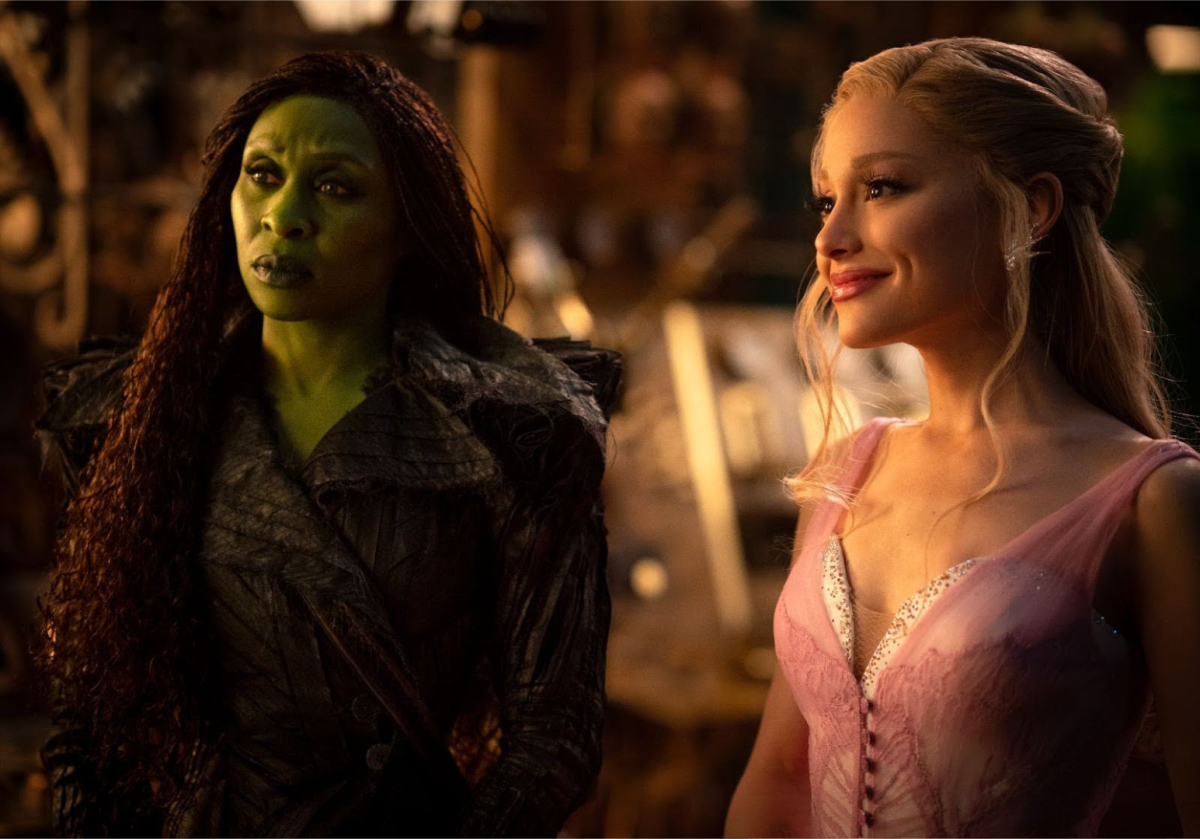
The sequel picks up right where the first film, “Wicked,” left off, following Elphaba Thropp and Glinda Upland’s journeys as two friends in positions that directly oppose each other.
To give a quick rundown of the first movie, Elphaba flies away on her broomstick after being branded the “Wicked Witch of the West” for saving animals and opposing the Wizard of Oz. Meanwhile, the second movie shows Glinda living her best life, uplifting public spirits and being showered with praise as the “Good Witch.”
The November 2024 “Wicked” movie is largely based on the Broadway show “Wicked: The Untold Story of the Witches of Oz,” which adapts Gregory Maguire’s 1995 novel, Wicked: The Life and Times of the Wicked Witch of the West, a twist on L. Frank Baum’s 1900 book, The Wonderful Wizard of Oz.
Because Baum’s story and the adaptations that came after it focus on one perspective, “Wicked: For Good” and its prequel offer a refreshing shift by presenting the same events from Elphaba’s point of view, who never had the chance to tell her side.
The new movie not only reinforces boundaries between Glinda and Elphaba but also reveals the hardships resulting from these limits that challenge their friendship — something everyone can relate to, despite not being a witch.
Visually, “Wicked: For Good” delivers striking contrasts between Glinda’s bright, pastel-filled world and Elphaba’s darker, suspenseful scenes. The film captivates the audience by creating a sense of reality, allowing them to see through the eyes of Oz citizens just with its graphics, whether it was Glinda floating down from the bright sky in a light pink bubble or Elphaba viciously zooming through the gloomy forest on her shabby broomstick.
“Wicked” sets the stage for its sequel’s attention to detail, as it ties its plot points together tightly. Turns out, even the small moments mattered, like how at the end of the first movie, Elphaba’s father faints, leading her sister, Nessarose Thropp, to rise to the position of the mayor of Munchkinland, a city in the land of Oz.
But audience members who do not remember specifics in “Wicked” could have trouble piecing these details together, which could make the story difficult to follow. Incorporating more flashbacks would allow viewers to appreciate the interconnectedness of the whole franchise.
Not only is the plot integral to the showstopping nature of the film, but music also plays a major role in “Wicked: For Good” as it guides the story using parallels to reflect the change in circumstances. For example, Glinda sings a shorter version of “I’m Not That Girl,” originally sung by Elphaba in the first movie when she realizes Fiyero, Glinda’s lover, does not belong with a girl like herself. The change in roles emphasizes that, even though the two friends are different, they face similar hardships, making the audience connect more deeply to the story and characters.
Compared to its first movie, “Wicked: For Good” lacks many catchy songs that stick, although the sequel incorporates more emotional music.
Even though “Wicked: For Good” plays for 2 hours and 18 minutes, the timing felt rushed toward the end of the movie, as most of the plot twists were suddenly exposed in a short amount of time — twists that aren’t worth spoiling. Compared to its sequel, “Wicked” is 2 hours and 22 minutes long, but maintains a steady pace in its plot.
Interestingly, “Wicked: For Good” finishes right where its prequel began, with Glinda explaining to the crowd what happened to the Wicked Witch of the West. This brings the story to a satisfying close as the new film completes a full circle plot-wise, making a third movie unlikely.
Though an additional film could explore Elphaba and Glinda’s reunion or delve more into the aftermath, it could be controversial to deviate from the iconic plot that many fans already love — also, keeping in mind that “Wicked” and its sequel stick to the Broadway show’s organization, with each movie following each act.
Part of the “Wicked” franchise’s success comes from its powerful and addictive songs paired with strong vocals. The first and second movies include all the songs in the Broadway show’s soundtrack, though they were slightly tweaked; “Popular,” “Defying Gravity” and “One Short Day” were lengthened.
Adding to the anticipation, “Wicked: For Good” features two new songs, “No Place Like Home” and “The Girl in the Bubble,” that were not a part of the original musical, according to a Thursday, Oct. 9 KFox article.
Although this deviates from the original Broadway show, it adds more depth to the story as the songs further reflect Elphaba and Glinda’s personalities and motivations through specific lyrics.
After the record-breaking success of the first movie, expectations for “Wicked: For Good” soared. With its detailed world-building and emotional storytelling, the sequel lives up to match its predecessor and proves its worth for good.

![Senior Michael Olivares (left), who plays the role of Mr. Wormwood, approaches sophomore Olivia Olsson, who plays the titular role of Matilda, as she clutches her book on Tuesday, March 3, in the Performing Arts Center [PAC]. The musical will debut tomorrow at 7 p.m. in the PAC.](https://shhsaccolade.com/wp-content/uploads/2026/03/DSC_0374-1200x800.jpg)