

The verdict is in: Sunny Hills’ production of “12 Angry Jurors,” inspired by the 1957 movie “12 Angry Men,” was a high-intensity performance well worth watching, with its own spin on the classic by casting male and female jurors instead of the original all-male cast.
After three months of preparation and practice, the Lancer Theater Company performed the play from Wednesday, April 29, to Saturday, May 2, at 7 p.m., with a one-hour-and-30-minute run time.
With the entirety of the story set inside the single jury room, 12 jurors, each with distinct personalities, backstories and perspectives, discuss the case of a 19-year-old on trial for murdering his own father. What starts as a near-unanimous decision for a guilty verdict is turned around when a single juror stands up and argues for his innocence.
When the life of a teenage boy is in the hands of a group of people who can’t seem to reach a consensus, the room is filled with lively arguments, uncoverings and moments to startle the audience out of their seats.
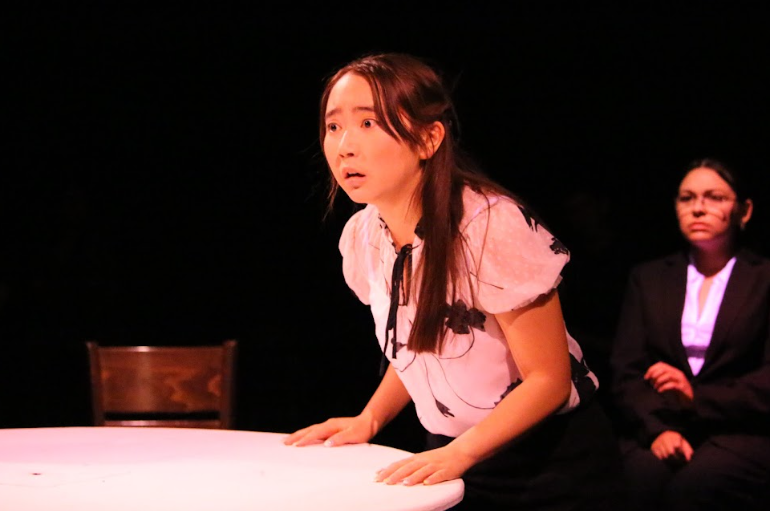
Saturated with tension and a sense of mystery, all student actors played their roles and conveyed their characters with passion, adding their own flair to the characters, bringing them to life as they unraveled each jury member’s background, from the gritty upbringing of Juror #5 to Juror #3’s broken family dynamic.
Senior Madeline Matheny’s performance as Juror #8, the sole juror who always stood by the boy’s innocence, was captivating enough to sway even the most decisive jurors. With an at first cool and calm demeanor, she successfully persuades the rest of the jury and even the audience of his innocence with raw emotion and impressive logic.
Playing the foil of Matheny’s character, sophomore Naomi Kim portrays Juror #3 as a constantly frustrated adversary to the boys’ guilt. As the story unfolds and the jurors delve deeper into the case, she slowly reveals her past as a mother with a dysfunctional relationship with her son. Kim conveyed her pessimistic emotions regarding her harsh fight for the death sentence with rage-filled outbursts and condescending comments, portrayed to make even the audience feel the radiated intimidation.
Following the pattern of the characters’ reactions stemming from beyond surface-level convictions, Juror #5, senior Mia Cho, is one of the first to alter her perspective and join the side of pleading for the boy’s innocence. As someone who grew up in the slums similar to the description of the convicted boy’s upbringing, Cho portrayed a passionate fight for innocence with a sense of sympathy and understanding. The character’s new perspective on the case makes the audience seriously question the evidence using reason, as well as altering their preconceived notion about the character’s seemingly naive personality.
Along with the performances, the stage’s design, although minimalistic, consisted of one round table with 12 chairs surrounding it and a single window with an intimidating clock hanging above it. With the story portrayed in one place, the lighting effects lead the show by conveying the individual standpoints of each juror, swaying between faith in the boy’s innocence and firm adherence to their initial guilty verdict.
Although the story was undoubtedly captivating, it was difficult to follow at times due to the jurors’ lack of names other than a number, and the case itself was somewhat of a mystery to the audience, despite small snippets of the trial being revealed and reviewed as they skim through evidence.
Nonetheless, despite the minor confusion, the story’s ambiguity serves the plot, adding layers of mystery and suspense.
Overall, the play effectively developed a subtle spin on a classic film with both suspenseful and heartfelt moments, leaving the audience’s positive opinions unanimous.







![Senior Michael Olivares (left), who plays the role of Mr. Wormwood, approaches sophomore Olivia Olsson, who plays the titular role of Matilda, as she clutches her book on Tuesday, March 3, in the Performing Arts Center [PAC]. The musical will debut tomorrow at 7 p.m. in the PAC.](https://shhsaccolade.com/wp-content/uploads/2026/03/DSC_0374-1200x800.jpg)

![Theater teacher Christian Penuelas (left), dance teacher Leiana Volen and choir teacher Aaron Duncan-Schwartz were recognized with the Orange County Music and Arts Administrators [OCMAA] Award on Dec. 12, 2025.](https://shhsaccolade.com/wp-content/uploads/2026/02/unnamed-4-1200x839.jpg)