

Escalating tensions in the Middle East, following the U.S.-Iran war that began on Saturday, Feb. 28, are disrupting global oil supplies and causing a spike in gas prices, bringing the effects of an international conflict to drivers across California, including students and teachers at Sunny Hills.
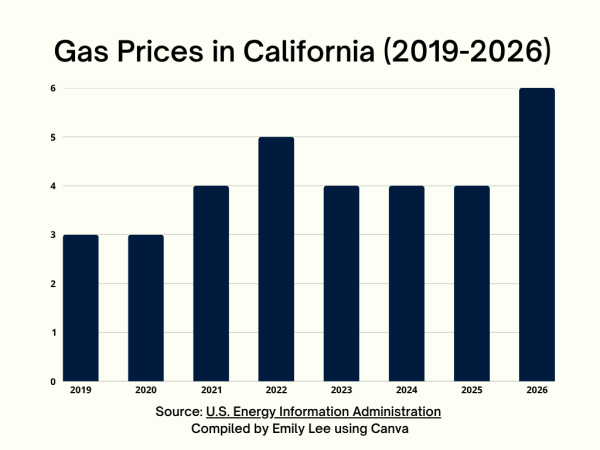
According to the American Automobile Association, since the start of the warfare, California’s average gas cost has climbed from $4.854 to $5.856 a gallon as of April 17, and in Orange County, prices rose from $4.783 to $5.869 over the same period.
For some, this spike in fuel prices serves as a reminder of the wider consequences of such combat, prompting concern over the ethical implications of U.S. involvement.
“It’s definitely concerning to see that the U.S. is in this position to harm others like this,” Advanced Placement [AP] Government and AP Human Geography teacher Carlos Quezada said. “I definitely don’t support war in any degree unless it’s self-defense, and I think if you can avoid war, then it’s best to avoid it; it should not be a first resort, it should be a last resort.”
Quezada, who receives most of his news from Associated Press News, National Public Radio and Reuters, said Iranian control of the Strait of Hormuz, a narrow waterway that carries about 20% of the world’s oil, is driving up oil and gas prices.
In turn, these rates inflate fertilizer and shipping costs for farmers, forcing them to raise grocery prices for consumers and businesses.
“I think it’s important to make very informed research-based decisions that are not impulsive and to think about how it would hurt others or other Americans,” the social science teacher said.
AP Government and AP Macroeconomics teacher Hera Kwon, who agreed that rising gas prices are making transportation and goods more expensive, said it is important to look at the impacts of these changes.
“We have to always carefully think through any kind of military engagement because we do live in a global economy and everything is interconnected,” Kwon said. “We might just be experiencing higher gas prices, but I anticipate that pretty soon, we’ll start to see more consequences that’s going to affect our pocketbooks in ways that we don’t want it to.”
David Wilde, who teaches AP U.S. History and AP Psychology, said the issue is less about hesitation and more about the necessity of ensuring stability in the international oil supply.
“I think the actions that we take revolve around access to oil and the free flow of it around the globe,” Wilde said. “So I mean, if it serves our best interest, I think we have to be involved in [such conflicts].”
As these global energy decisions ripple outward, their impacts, though more limited, are increasingly visible in the day-to-day lives of these SH teachers.
Kwon admitted higher gas prices have not impacted her much because she rarely drives far, filling up about once every two weeks and commuting only five minutes each day. She said she occasionally drives to Los Angeles to see her friends but mostly travels short distances between her house and work.
“I don’t really think about [the price] too much, but I do see it,” she said.
Echoing Kwon’s experiences, Wilde, who drives a mile from work to home and back, said the inflated gas prices are not affecting him personally, as both him and his wife do not commute far.
Although he also has a short 10-minute commute, Quezada said he still makes financially aware decisions on a regular basis.
“I definitely think I’m more mindful about how far I drive and what I’m spending my money on because things are more expensive, so I’m not going to treat myself on a lot of different things,” he said. “When I choose to travel to L.A. or San Diego, wherever it is, I ask, ‘Should I travel’ or ‘Do I really need to go over there for this?’”
SH students report having to follow a similar financial mindset.
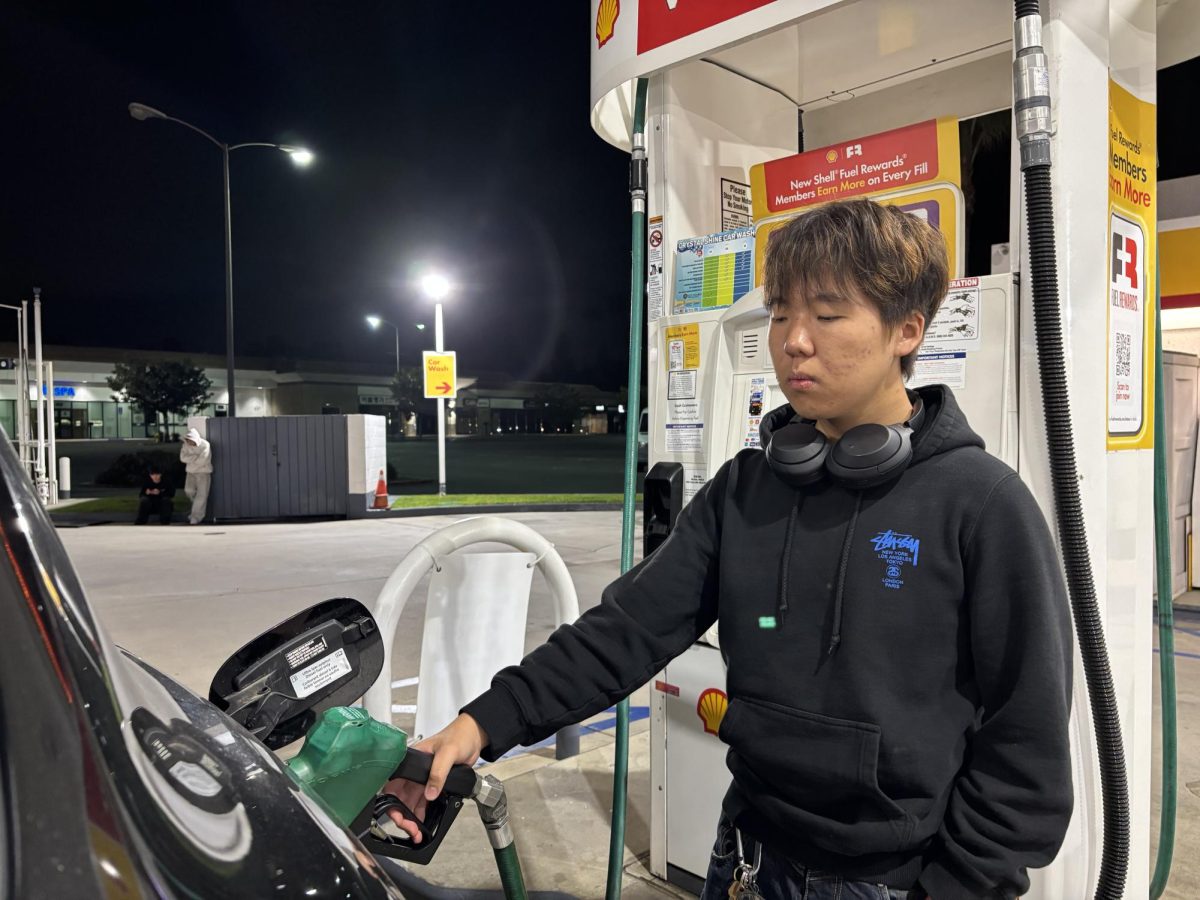
Senior Ian Chung, who drives his diesel car to school every day, said he spends around $130 to fill up one tank of gas and refills it once every other week.
“I take a shorter route to school now, so it takes me like 10 minutes, and I’m not eating out as much anymore with friends,” Chung said.
From paying $30 to now $50 for a full tank, senior Jadyn Salud, who said he drives to school, volleyball games and church, confirms the effects of rising fuel costs on his routine.
“I don’t go as many places as I want to,” Salud said. “I have been driving less and driving not as fast as I used to.”
Similarly, senior Jacob Michaels said he has felt the strain of these higher prices, as he pays $70 for one tank and faces roughly $300 monthly gas costs. Each of the students admits to making changes in their daily lives in response to this inflation.
“Every time I go out, I mostly carpool and make people with electric cars drive me,” Michaels said. “I also had to stop going out to get food.”
After making these adjustments to manage the spike in gas prices, the three student drivers said they are open to alternatives to gas-powered vehicles.
“I want an electric car now because I think they’re better for the environment since they’re mostly clean air,” Salud said.
Electric car driver junior Melody Sonboli confirms the benefits of these types of vehicles and said her daily routine of going to school and volleyball games has been unaffected.
“Since I can just plug in my car and not have to worry about recent gas prices increasing, I can continue on with my weekly drives,” Sonboli said. “I think situations like this could encourage more people to consider electric cars, especially since they don’t rely on gas and can be more stable cost-wise.”
As these rising fuel costs continue to shape daily choices among SH students and staff, the discussion of long-term solutions in transportation, including a shift toward electric and more sustainable energy sources, opens up.
Fueling an electric vehicle generally costs 60-70% less per year than a gas-powered car as of April 2026, often resulting in almost $1,000 in annual savings, according to the U.S. Department of Energy.
“I think focusing more on renewable energy could be helpful because it would make the country less dependent on global oil and could be better for the environment in the long run,” Sonboli said.
Similarly, Quezada attributes such price hikes to a more ethically mindful society and a larger electric car movement.
“We do need to minimize the impact of fossil fuels, but trying to find a way that’s affordable and also upholds proper standards, like for example, being mindful of how we’re getting the minerals for electric cars and making sure it’s fair labor practices and fair treatment is important to consider,” he said. “[The higher gas prices] are showing that [individuals who own electric cars] are saving a lot of money; I definitely support electric cars, and I think it’s great that there is a movement to shift away from fossil fuels and do more renewable energy.”
According to CBS News, temporary ceasefire agreements and peace talks between the U.S. and Iran have emerged, but they remain fragile and have already shown signs of breaking down. Until a more permanent solution is reached, gas prices are likely to stay unstable, leaving California drivers uncertain about how much they will be paying at the pump in the months ahead.