



It all started with a bet.
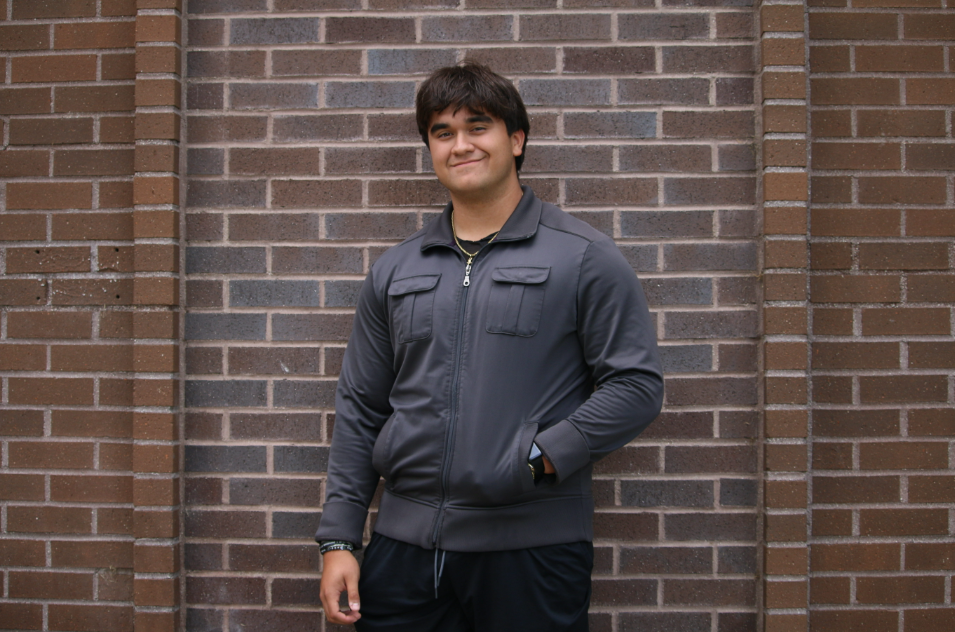
On the second day of his freshman year, sophomore Julian Lee said his best friend sophomore Ayden Paguyo made a declaration: he was going to join the Sunny Hills wrestling program.
Instead of responding with encouragement, Lee countered with provocation.
“I said, ‘I bet I could do it better than you can,’” Lee said. “So, it was a bet between the two of us, and that’s what made me join wrestling.”
Since stepping inside a wrestling room for the first time two weeks after the bet, Lee, who has juvenile retinoschisis, a degenerative eye condition, has never stopped loving the sport, battling through physical and mental obstacles, including a clavicle fracture in March 2025.
DEALING WITH EARLY VISION LOSS
Born fully sighted and able to see clearly until around 4 years old, the wrestler said his vision progressively worsened, the most drastic change occurring from sixth to eighth grades.
“It was challenging because I knew how to read a little bit and write a little and was used to seeing things,” he said. “It was weird having to read Braille for the first time when I was 5 and having to feel around instead of looking.”
The sophomore said he felt fear and frustration regarding his situation. Currently, Lee’s vision is completely blurred, requiring him to use a cane.
“Obviously, your parents can’t really explain to you what’s going on because you don’t have the mental capacity to understand that your vision is failing,” Lee said. “I was scared and angry because I was questioning, ‘Why is this happening to me?’”
STEPPING ONTO THE MAT
Though he sometimes felt overwhelmed with negative feelings as his vision worsened, Lee said joining wrestling helped him notice the positive aspects.
“It wasn’t apparent to me then, but it’s more apparent to me now; [being blind] helps me with wrestling because everything is off feel, so I know when I do a technique wrong because I could feel extra resistance or something feels off,” he said. “I grew accustomed to it and realized the benefits of it.”
The sophomore said the process of getting on the team was different from other sports. Challenge matches — in which any athlete can request a duel with another of the same weight class — replaced tryouts; Lee challenged Paguyo for the 120-pound weight class spot, but lost.
“I was disappointed because I had lost and I didn’t like losing; however, I felt motivated to get better and I hoped that he would get better so that when we did challenge each other again, it would be more competitive,” he said.
Despite this defeat, Lee officially became part of the program, automatically placed in the 113 lbs division instead of the 120-pound class since he lost his duel.
“The challenge match taught me to be fast because he was stronger than me, but I felt I was a little faster,” said the wrestler, who didn’t prepare specifically for the duel. “It also taught me that you have to use your skills to your advantage; you have to use as much as that advantage provides you.”
As a complete newcomer to the sport, Lee said it took about a month to get adjusted to the environment.
“It was hard because I wasn’t used to coaches pushing you to your limits and having to wrestle for three hours every day; it was gruelling,” he said. “But once I got used to it, it got more manageable.”
A BUMP IN THE ROAD
The wrestler said the most challenging aspect of being visually impaired was competing in tournaments.
“At the time, I was like, ‘I’m blind, I’m probably gonna lose’ or ‘I don’t know what to do, I’m really bad at this;’ those were the obstacles,” he said. “But then I learned to think, ‘If you just practice and lock in, it doesn’t matter if you’re blind.’”
Despite his eagerness to continue with the sport, Lee’s wrestling journey came to a halt in March 2025 when he broke his left collarbone during a practice after the season had ended.
The sophomore said his doctor told him he wouldn’t be able to wrestle for about four months.
“I had to get surgery and they had to put a plate into my shoulder to hold the bones together while it healed,” Lee said. “I was discouraged a little because of the surgery.”
Rather than viewing this moment as an opportunity to give up and take the easy way out, Lee said the injury rekindled his love for wrestling.
“It’s a combination of wanting to do a sport, wanting to be like the best at your sport and knowing people in the sport that made me want to continue.”
Although he’s now fully recovered, Lee’s parents said they remain hesitant about allowing him to restart his wrestling journey this season.
“When I first knew he wanted to wrestle, I was apprehensive as our family wasn’t big in sports, especially a sport so demanding like wrestling,” his mother, Soo An, said. “Ever since Julian got injured, I don’t want him to get hurt again, and I feel as if him being blind is such a disadvantage.”
However, Lee said that he feels recovered and ready to compete.
“I feel like since March, I feel 120%,” the wrestler said. “I feel faster and stronger since then.”
“LIFTING” UP HIS COMMUNITY
Assistant wrestling coach Fernando Mora said his first impression of Lee was that he was full of purpose and passion.
“I noticed his desire, want and drive to wrestle, which is the big key in any sport, especially wrestling because it’s so demanding,” Mora said. “But, he had no fear; he did what I said and listened.”
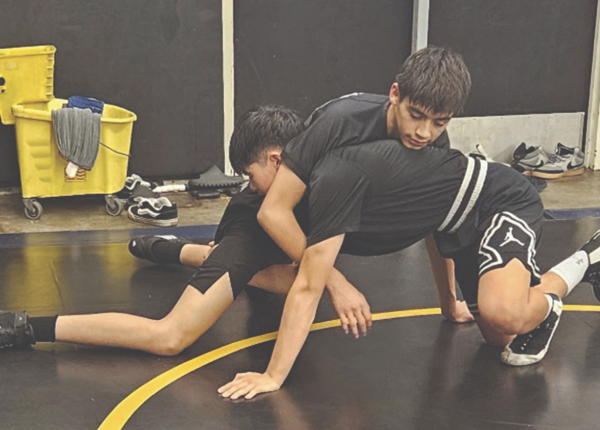
To accommodate Lee’s visual impairment, Mora said he attempted to change his coaching style, focusing on hands-on instruction.
“It helped me to perfect my coaching technique,” he said. “A lot of the time, I would wrestle with him to teach him the moves so he could feel it.”
Senior Dylan Miranda offered to be his personal coach — giving Lee more assistance on the mat — because he was unable to wrestle after an injury, helping him learn moves and improve as an athlete.
“A special moment is probably when he first started learning, when he was able to start getting his first takedowns and really learning his style of wrestling, because it was a lot of experiment, see what works for him and what doesn’t,” Miranda said. “He’s extremely hard working, and he’s confident about what he could do.”
An said she respects his determination to be outstanding.
“I think Julian’s biggest strength as a student and his entire life is that he wants to be the best he can be and wants to continue learning,” his mother said. “This translates well into wrestling as he wants to perfect every move and position until it’s second nature to him.”
Paguyo said Lee’s bet also motivated him as an athlete.
“After Julian made the bet, I felt some competition and excitement that my friend was going to join wrestling,” said Paguyo, who has been friends with Lee since seventh grade. “Happiness because I was grateful that my friend was going to join wrestling with me and competitiveness because I would be able to go against my friend.”
In addition to wrestling, Lee said he began jiu-jitsu in November 2024 after Mora recommended him to work with Class of 2024 Liam Kim, a former wrestler, to sharpen his skills.
Though currently on a break from both sports because of his recent injury, Lee said he plans to return as soon as he receives permission from his parents.
Aside from absorbing the fundamentals like the stance and lateral movement, Lee said wrestling taught him important lessons like time management and responsibility, which he applies in his daily life.
“In junior high, I would have a lot of missing assignments because I was young and didn’t manage time properly,” he said. “But since you’re committing so much time every day, you have to learn to manage your time, so that you don’t fall behind and you can’t wrestle anymore.”
The sophomore said when it comes to the sport, he is inspired by the Ultimate Fighting Championship [UFC] fighters who shine on the big stage.
“In the UFC, my favorite fighter Islam Makhachev [who excels at] grappling because that’s what I’m familiar with,” he said.
On days when training felt grueling or hard to handle, the sophomore said watching the UFC inspired him to continue practicing.
“It motivated me because I see talented people being in the best shape of their life, being the best fighters they can be,” he said. “I said, ‘I want to be something like that,’”
Lee said he hopes he can continue to grow in the sport, as it has taught him so many valuable lessons.
“I learned to work hard and be persistent because you’re going to face obstacles, whether it’s, you lose, you can’t get a move right or you can’t get stronger,” he said. “You have to keep pushing and persisting.
“If you push, you’re going to make gains; if you don’t, you’re going to plateau.”


![Students in the Leadership Education and Development [LEAD] program pose after learning about leadership in the cafeteria on Wednesday, April 29. This is the LEAD program’s second year.](https://shhsaccolade.com/wp-content/uploads/2026/04/IMG_4314-1200x873.jpeg)