![Students in the Leadership Education and Development [LEAD] program pose after learning about leadership in the cafeteria on Wednesday, April 29. This is the LEAD program’s second year.](https://shhsaccolade.com/wp-content/uploads/2026/04/IMG_4314.jpeg)

The sun was going down, and so was the track and field team’s energy and confidence.
With drowsy movements, students were already packing and cleaning up before the last race began.
The normally loud and lively students were silent and worn out, patiently awaiting the signal to go home.
Until a few words of encouragement made a difference.
It was a meet at Buena Park High School on Thursday, March 26, and sophomore Abby Paguyo said her small speech improved the team’s morale and even their overall performance.
“I could tell everyone was drained and ready for the day to be over,” Paguyo said. “We gathered before our race, and I gave us a little pep talk, something not too crazy but enough to motivate and encourage my team.
Paguyo said the team was hyped up, as students continued the pep talk one by one, adding their own cheers and encouraging each other to do their best for the next race.
She said her words especially impacted her peers because they came from a usually quiet person.
“I think speaking up meant something to them because I’m a little quiet,” the sophomore said. “Later, I reflected and realized that if I had been in that situation a year earlier, I wouldn’t have opened my mouth.”
LEARNING TO LEAD
The main change from a year earlier is that Paguyo is now in the Leadership Education and Development [LEAD] program, created by athletic director Paul Jones and assistant athletic director and girls basketball head coach Jae Byun to improve leadership skills for student athletes.
To develop these future leaders, Byun said LEAD aims to provide opportunities to showcase and grow leadership in ways students were previously unable to.
“It gives a chance for some of these emerging leaders to step out of their comfort zone, learn about themselves,” Byun said. “It just kind of accelerates the leadership development for them before they get to the real world.”
In 2024, Jones came up with the idea of a leadership program for sports. He said that he and Byun recognized the importance of one, which they consistently discussed until it was officially established last school year.
“We started talking about what it would look like to have a leadership program for our student athletes and try to devise some things that we could do to just help encourage and promote leadership within our school and in our sports teams,” Jones said.
Other schools in the Fullerton Joint Union High School District, like Troy High School and Sonora High School, have variations of leadership programs, but Jones said LEAD was not modeled after them.
Compared to these schools, Byun said the Sunny Hills LEAD program differs in content as well as in the continuous efforts to maintain it.
“I actually think ours might be the strongest in terms of just consistency, but also the curriculum that we go through,” he said. “I just feel like we have a pretty solid system and our school does a great job supporting us with this program.”
Byun said LEAD was specifically inspired by the idea of educating and defining leadership.
“I think it’s important because it allows conversation about leadership to come up,” Byun said. “I think leadership is such an elusive term sometimes, like what does good leadership look like?”
HOW IT WORKS
For LEAD, head coaches from each sport select between two and four students within their varsity team to join the program.

Byun said other changes are necessary because, despite its first year’s success with 35 students, he noticed some areas for improvement.
“I think there were also moments of like, ‘OK, we can grow in certain areas and improve,’” Byun said. “I thought we had to clean up some of our consistency, like how often we’re meeting, and then even within the curriculum, different things that I felt like it was too much.”
LEAD is a year-long program with monthly meetings in the library or cafeteria during the first and second periods or third and fourth periods. Attendance is mandatory, and as a consequence of repeated absences, students are removed from the program.
These meetings consist of all 50 students, where Jones and Byun aim to teach important leadership skills through PowerPoint presentations, interactive training, role-play, personality tests and other methods.
More specifically, during these meetings, Jones said he emphasizes the critical role a leader plays.
“Because you’re a leader, people are always going to look to you, and so, how are you using your influence?” Jones said. “Those are some of the things that we’re teaching the kids, how to use their influence and leadership, but also how to reflect and look at themselves.”
Sophomore Kate Gong is in LEAD, representing girls soccer, and compares these meetings to an actual class, as she said that after completing activities to get to know other members, they read articles and answer questions about leadership.
Gong said that through these meetings, LEAD gave her a stronger understanding of herself while enhancing applicable leadership skills.
“There’s a lot of stuff that I realized about myself because it’s not only leadership, but it’s also personality and getting to know yourself more,” Gong said. “There’s a lot of stuff I can apply on the field that I didn’t know.”
Agreeing with Gong, sophomore Aaron Yoo in track and field said his leadership allows him to support his team while helping them learn.
“I used my new skills to benefit [my team] by cheering them on and teaching them about my hurdle technique with my communication, and I would always be patient with them and correct them if they are doing anything wrong,” Yoo said.
CHANGE IN LEAD-ERSHIP
Track and field coach Jacob Holloway said he recognized Paguyo and Yoo’s changes after joining the LEAD program, noting their dedication and stronger influence on the team.
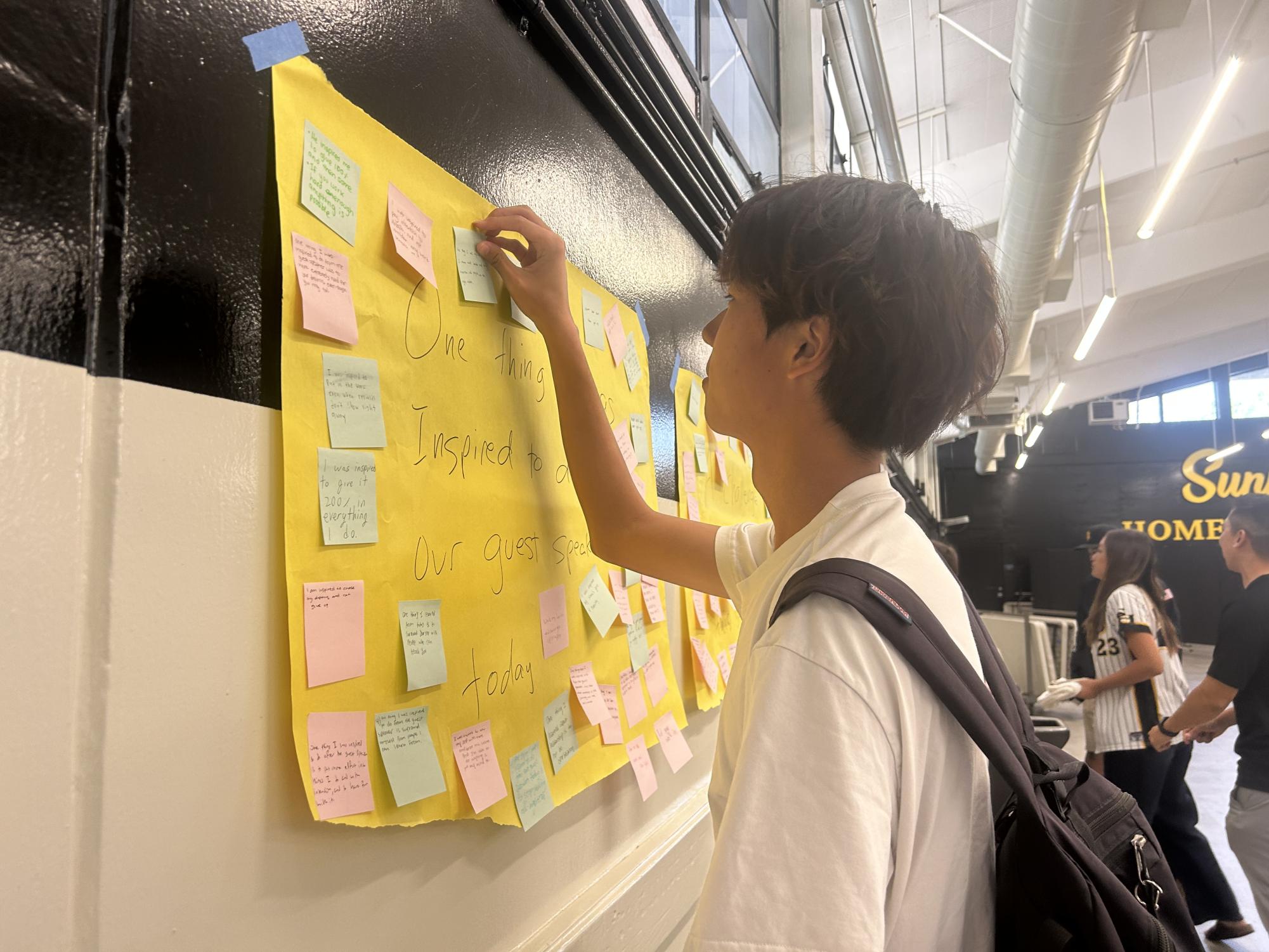
The LEAD program’s primary goal is to refine leadership skills, and Jones said it is important for students to become effective leaders, rather than focusing on being well-liked.
“We want to make sure that the leaders are leading in the right way,” he said. “There are some kids on sports teams or even on campus where people follow them just because, ‘Oh, that kid is cool, so I’m going to follow them,’ but they might not necessarily be the best leader in leading people to go do the right things.”
Paguyo said LEAD is meeting this objective as well, as she said she learned a deeper significance behind leadership.
“The LEAD program has broadened my understanding of what it means to be a leader,” Paguyo said. “They make these athletes aware of what being a leader means and the responsibilities that come with it.”
In the LEAD program for Dance Production, junior Leni Nam said her involvement enables her to speak more openly about ways to help her teammates improve.
“I can easily just speak up and give corrections more easily, compared to last year when I thought I didn’t have leadership skills,” Nam said. “The program is helping me become a better leader.”
Holloway said he agrees with LEAD’s effectiveness and purpose.
“Coach Byun has done an amazing job coordinating and conducting the workshops,” he said. “I also think it’s beneficial for athletes in our school to interact with each other in a constructive manner, addressing similar issues and sharing ideas.”
Gong’s personal goal aligns with the LEAD program’s emphasis on teamwork and positive communication, both of which are crucial parts of leadership.
“It really teaches me to not only respect other players, but to build good relationships with them through good communication and empathy,” Gong said. “I have a problem with body language, and I learned that negativity can really affect other teammates, so my goal is to change my negative body language to more positive.”
Outside of athletics, Gong said her change in body language helped in aspects of her home life, even in small ways.
“I use my new body language with my family,” she said. “Even though it’s hard, I still try to keep a relaxed expression to avoid weird looks from my mom because I know she’s working all day and it can be hard to stay positive for her too.”
In addition to helping his team with hurdles as the hurdle captain, Yoo said the LEAD program has taught him to be more confident while helping his peers in math.
“I would say [I use my new skills in] Algebra Center because I’m less afraid to talk to strangers, and I could patiently tutor them math problems,” he said.
MORE LEAD-ING TO COME
Jones said he and Byun are considering making LEAD focused on freshmen and sophomores next year to continue ensuring there are different students and grade levels every year.
As for broader future goals, Jones said he hopes to keep the LEAD program running for many years to come, despite what challenges might occur.
“As times change, we will continue to evolve and grow with the students with different implementations,” the athletics director said. “Leadership in 2026 does not look the same as it did in 1996 or 1986, so as time moves on and we learn and see different things, we evolve and grow with it.