



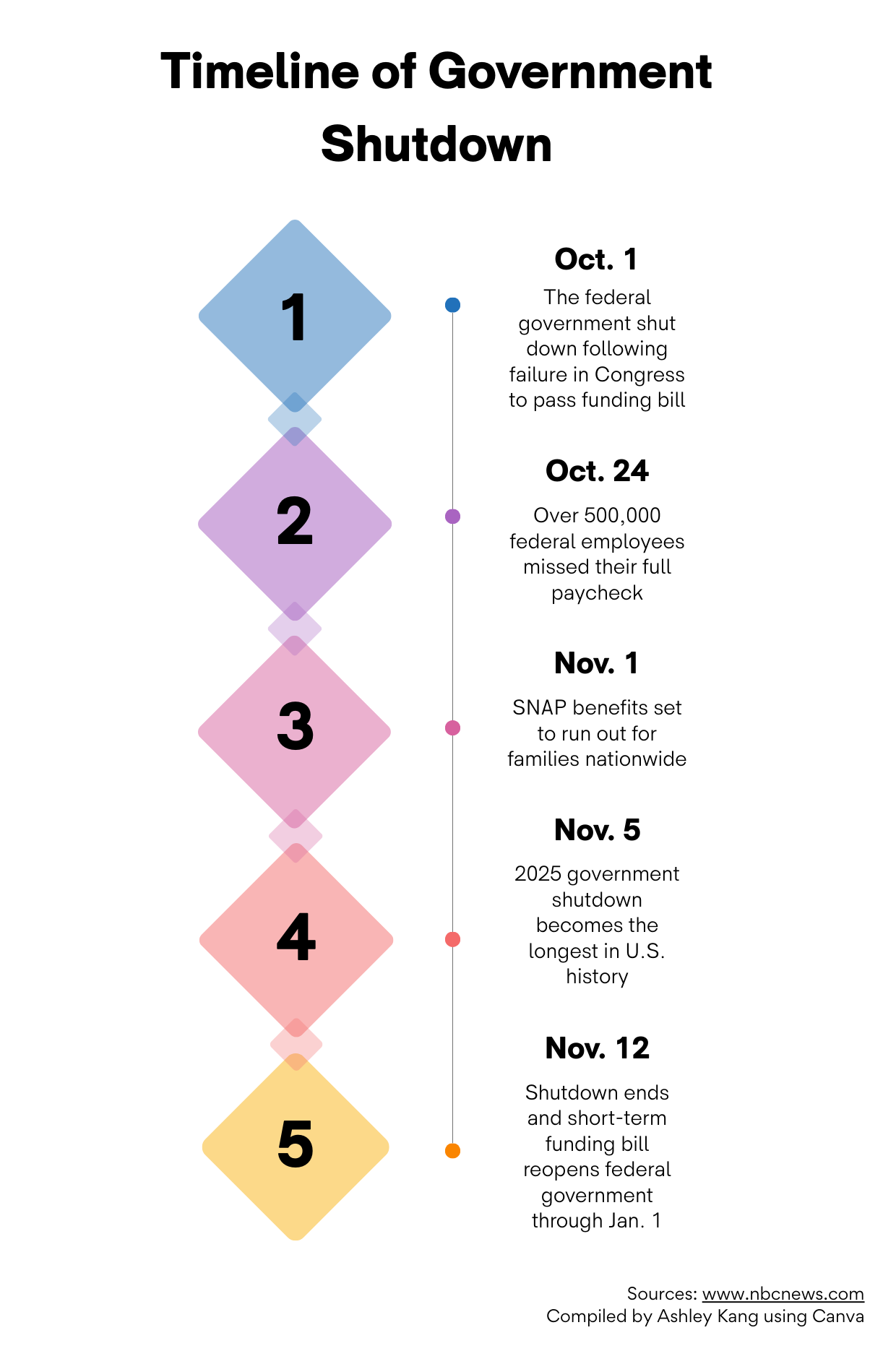
Following a budget dispute over the yearly federal funding bill, the recent government shutdown became the longest one in history at 43 days.
“I’m not surprised,” said Advanced Placement [AP] Government teacher Carlos Quezada. “You know, we’re very hyperpartisan, very divided, and that’s just been increasing over the years.”
A government shutdown occurs when Congress and the president disagree on and cannot pass the yearly budget, causing delays in federal operations and costing the economy billions of dollars.
Although none have lasted as long as the 2025 shutdown, the U.S. has faced several in recent years: the one in 2018-2019 lasted 35 days after a disagreement in Congress over funding for a border wall, while the 2013 shutdown lasted 16 days over funding disputes for the Affordable Care Act.
In this case, the 43-day shutdown occurred as Congress was unable to reach an agreement on which programs and priorities to include in the bill before the Tuesday, Sept. 30, deadline.
News of the recent government shutdown left many students, including senior Ashley Moon, worried about its effects on federal financial aid for college tuition.

concerned for the recent government shutdown’s effect on federal financial aid programs. (Katie Leem)
“If I’m being honest, I initially didn’t think much about it,” Moon said. “But when the shutdown dragged on for an extended period of time, I began to worry about what might be the consequences of it.”
Student financial aids such as Pell Grants are federally funded, meaning they were unavailable during the shutdown. However, the Free Application for Federal Student Aid [FAFSA] process, which determines a student’s financial need and connects them to educational grants and loans, still operated because the program was supported by pre-existing funds, according to the U.S. Department of Education.
According to FSA Partners, some customer service contact centers were closed, causing a delay in returned calls, emails and messages until the government reopened.
“When I applied for FAFSA, I didn’t see any difference in it, so I was grateful for that,” said senior Rudra Kharwa, who found the process surprisingly easy during the shutdown.
Upon hearing about the shutdown, Quezada said he was concerned for the people who normally rely on federal funds.
“I was frustrated because I’m a strong believer in the well-being of all people, especially those who need food and need to have access to the resources,” he said. “I think everyone should have access to the means to live; money shouldn’t dictate whether you live or die.”
The Supplemental Nutrition Assistance Program [SNAP] food aid benefits, which provide students with monthly funds to purchase groceries, were suspended for 42 million low-income Americans until officials ordered that full benefits be issued on Friday, Nov. 14, according to The Guardian.
“I feel like there was no need for the government to shut down something like SNAP because I know it’s beneficial for a lot of families,” Moon said.
Quezada said the district did a good job in providing food aid programs for students and their families.
“I was happy to see that the district was doing some great things for the kids,” he said.
The AP Government teacher said he discussed the government shutdown with his classes, covering topics including hyperpartisanship and the bill-passing process.
“I want them to always make the connections of what we’re learning about how our government works to the real world,” he said. “I really want them to see how everything we learn is applicable to real life and find value in that.”
AP Government teacher Hera Kwon said she also talked to her AP government class about the shutdown.
“We were learning about Congress and the legislative branch, so it definitely intersected,” Kwon said. “And with my regular government class, it’s something I plan to talk about when we get to the legislative branch.”
The shutdown ended after the president signed a continuing resolution [CR], a temporary measure that keeps the government running by funding federal operations at the previous year’s levels until a new budget is agreed on.
Because the CR expires on Friday, Jan. 30, Congress must pass full-year funding bills by then to avoid another government shutdown.
Kwon said that although she is unsure whether there will be another shutdown, she hopes it can be avoided.
“It really depends on how willing the president and members of Congress—the Republicans and Democrats—are to compromise,” Kwon said. “But I hope, when they’re ready to negotiate a new budget, they’ll be able to reach an agreement.”