

Cold to the touch.
Translucent as glass.
Retains the shape of a cube.
It stretches and pulls like thick slime, only to shift back into its crystalline shape the moment it’s released.
This is the Nice Cube — the crown jewel of the NeeDoh lineup.
While the unofficial term “squishies” serves as the broad category that defines a decade of soft, malleable toys, the viral brand NeeDoh shines among others as the center of the buzz.
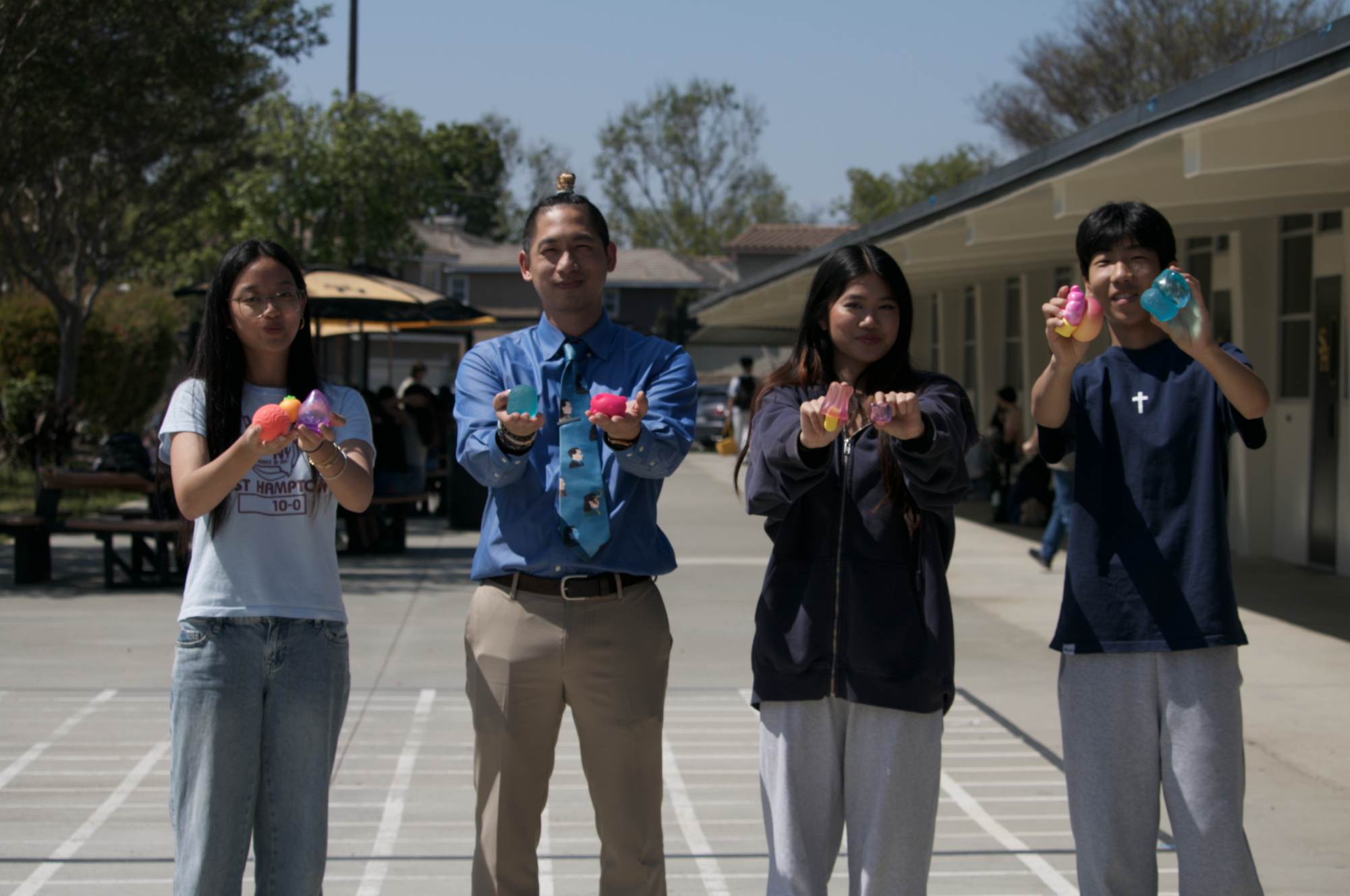
At Sunny Hills, these trinkets have become integral in campus life as daily conversation starters, stress relievers and essential sources of stimulation for Lancers, destressing the daily lives of students and staff.
THE “SLOW RISE” TO THE TOP
Though many believe this trend of squeeze toys began just recently, the craving for these items dates back centuries. According to a November 2022 TJM Promos article, the first squeezable fidget tool appeared in the Han Dynasty, when warriors crushed hand-held walnuts to stay mentally focused in battle.
Junior Leah Nyberg said that although she is familiar with the recent stress toy trends, the historical background of fidgets surprised her.
“I had no idea the first stress toy went that far back,” Nyberg said. “I think it’s interesting how humans, even back in ancient times, were anxious and in need of stress relief.”
Over time, this need evolved from Baoding balls in the Ming Dynasty to the first-ever stress ball in 1988, created by American television writer Alex Carswell, according to a November 2022 article from The Medium.
The classic squeezable blue ball made of polyurethane, a highly versatile polymer, soon developed into various shapes and styles, with multiple brands such as iBloom and Taba Squishy branching into the sensory toy category. Schylling, a toy company based in Boston, jumped on the wagon and launched the NeeDoh in 2010 — a soft, stretchy toy with a polyvinyl acetate filling encased in thermoplastic rubber, according to The Daily Campus.
Still, the NeeDoh didn’t find its fame right away, as others following the Japanese “kawaii” culture, often resembling cute animals, fruits and desserts, established their place in the YouTube and Instagram communities, according to RebeccaDeczynski.com. Squishy YouTube creators like Moriah Elizabeth and Doctor Squish gained millions of followers through their content, helping promote the toy to a larger audience.
Sophomore Khloe Fung said she remembers being influenced by such videos in her childhood.
“When I was little, I would watch the squishy unboxing videos, and the ones where they remade them and painted over old ones,” Fung said. “I thought they were so cute, I had a bucket full of them.”
Senior Emily Gonzalez also remembers the craze over the foam squishies in her childhood, and said she recalls a box of over 20 of them under her bed.
“I just thought they were satisfying, and they were also trending, so I thought they were really, really cool,” Gonzalez said. “I even used to try to make them from scratch; I was obsessed with them.”
Overshadowed by the foam squishy craze, Schylling introduced a widening range of sensory toys, including SqueezDoh, BlastOhs and Chewelz, but according to the official NeeDoh website, NeeDoh became their top-selling product by 2015. Despite its overall popularity among the company’s products, it wasn’t recognized as a top-selling product like Shopkins or fidget spinners at the time, according to a September 2015 PR Newswire report.
Meanwhile, by 2017, squishies from main brands at that time, such as i-Bloom and Creamiicandy, were deemed “the next fidget spinner.”
According to a May 2025 Metmo article, fidget spinners were “everywhere” during 2016-2017, so much so that all of Amazon’s top 10 best-selling toys were fidget spinners in May 2017. Nyberg said she remembers the trends during her own elementary school years.
“Fidget spinners and Pop-Its were the most popular fidget toys in my school,” she said. “I loved collecting those, and I envied the cool kids who had the Pop-Its lunchboxes and backpacks.”
However, search interest faltered in June 2017, according to FiveThirtyEight ABC News, while tags like “squishies” and “squishy toys” saw a steady climb throughout 2017 and peaked in December 2017 according to Accio, paving the way for brands like Squishmallows, Taba squishies and eventually NeeDohs.
Freshman Brandon Kim, a previous fidget spinner collector and current owner of eight NeeDohs and three squishies, said that while spinners are more about motion, squishies focus on textual satisfaction.
“This is sort of the same thing as fidget spinners and Pop-Its since they both satisfy me, but the textures of spinners and NeeDohs are different, and NeeDohs feel better overall,” Kim said.

NEED(OH) THAT
With the stage set, NeeDoh found its first path into the spotlight in 2020 amid the pandemic, then resurfaced even stronger in 2025, according to a March 5 The Daily Cardinal article.
But the true burst of popularity didn’t happen in a toy store, but on the For You Pages of millions of teenagers. Sophomore Hannah Pinsky, who has observed the NeeDoh craze from a bystander perspective, said she sees squishy-related videos regularly.
“I see a bunch of those NeeDoh videos or the glitter dumpling unboxings on my page, and even though I don’t especially have an interest in them, it makes me want to buy one,” Pinsky said.
Instagram, YouTube and especially TikTok display hundreds of NeeDoh-related videos, both from the official NeeDoh account and from prominent influencers fanning the flames. Their official account grew from 5,000-10,000 views per video in 2021 to several hundred thousand views per reel in 2025, with their most popular currently racking up 7.8 million views.
Influencers share a variety of NeeDoh content, ranging from collection tours showing off their picks of the day to visual autonomous sensory meridian response [ASMR] reels, showcasing the satisfying squeezes on screen with whispers, taps and scratches.
Owner of seven NeeDohs, senior Sophie Yu credits social media for the sudden spike of interest in the sensory toys.
“People on TikTok are promoting it like crazy, like, ‘Go get your NeeDohs,’ all of a sudden, so I think that’s how it randomly got popular,” Yu said. “Especially how NeeDoh came out with a bunch of these new shapes and styles, it’s always through social media that lets the public know.”
Schylling reported having sold over 100 million units of NeeDohs in 2025, according to a Dec. 16 Consumer Reports article, and Accio reports that the search volume of squishy toys on platforms like Amazon and TikTok has more than tripled in the first quarter of 2026 compared to late 2025.
The diversification of NeeDohs throughout the years has increased the company’s product list since the first Groovy Glob was launched in 2010 — the NeeDoh Nice Ice Baby, Teenie NeeDoh, NeeDoh Gumdrop and NeeDoh Dream Drop are some of the first products showcased in the “sort by popularity” tab in the online store. These take different shapes, colors, sizes and textures, but all fit NeeDoh’s primary goal of “squeeze it, pull it, smush it and then watch it return to its original shape,” a slogan found on the official NeeDoh website.
The variation has buttressed interest rates among Lancers, as it accommodates each person’s preferences. Kim shared his favorite kind of NeeDoh and the special texture that heightens his gravitation toward the product.
“My favorite Needoh is the Nice Ice because when frozen, it can be hard, and when shown to the sun, it turns soft,” the freshman said. “I like how some can be different textures and sizes.”
Fung, known among students for bringing a Lululemon bag full of squishies daily, said the versatility of the fidget toys appeals to her and others the most.
“NeeDohs are my favorite squishy brand because they’re really cute, and they have a bunch of different kinds and different colors, which makes them more interesting,” Fung said. “I bring them every day because I like to play with them, and other people like to play with them as well.”
At Sunny Hills, the return of the squishy is also a chance to connect within the community. Science teacher Alexander Hua said he incorporates his two NeeDohs he purchased in February to engage his students and relate with them.
“Sometimes I use it to motivate my kids,” Hua said. “Like, if they want to play with my NeeDoh, they have to get their work done first; it’s kind of useful in the classroom that way.
“I just like collecting things that I can relate to the kids with, that kids are into, because it’s another way to connect.”
Distinguished from the several other collectables he’s had experiences with in the past, including comics, Labubus and Sonny Angels, he said NeeDohs are the most meaningful to collect.
“This is something kids can fidget with and interact with, which I think adds to the appeal of interactability versus a Sonny Angel, which is just kind of there,” the teacher said.
However, for freshman Miya Siregar, a retired collector, the obsession with grabbing every collectible on her list has lost its charm.
“Honestly, as much as I love them, having a collection is absurd,” Siregar said. “One is enough, and having more than seven is absolutely wild because you might not even use all of them.”
But the appeal of NeeDohs doesn’t stop at collectability to Lancers. Introduced to the world of squishies by Yu, senior Amir Ragnath, who enjoys NeeDohs but doesn’t currently own one, said he loves squishies because they encourage friendships to form.
“I feel like they bring people together,” Ragnath said. “Ever since Sophie started bringing her NeeDohs, we became better friends.”
Fung shared a similar experience during a 2025 winter retreat at St. Raphael Korean Catholic Center. After bringing a few squishies with her, she said she found herself surrounded by curious peers.
“People I didn’t even know wanted to touch them,” the sophomore said. “I made a lot of friends through that experience.”
Sophomore Felicia Hahn, who was among those who befriended Fung through the squeezable toys, said although the soft texture appealed to her at first, the conversations that followed were most memorable.
“Playing with Khloe’s squishies at retreat and talking about it made me become closer with her through the conversations we had about which squishy was the best and why,” Hahn said. “We also talked about it with other friends, and it ended up being a big conversation with everyone, which I enjoyed.”
LET’S GO “NEEDOH HUNTING”
Another social media trend that arose amid the NeeDoh frenzy is “NeeDoh hunting.”
“NeeDoh hunting” involves searching retail stores like Target, Walgreens and CVS for NeeDohs, which are rare to find as shelves are emptied the day stores restock, according to a March 5 article from NJ.com. Gonzalez, who works as a Target employee, sees the NeeDoh frenzy firsthand.
“I’ve seen a lot of people go crazy over [NeeDohs],” Gonzalez said. “They literally sell out 10 minutes after being delivered to the store.”
The scarcity of these squeezable products kept students from getting more, even if they wanted to. Freshman Audi Bagnol said she’d had numerous attempts but failed every time.
“I only have one blue NeeDoh, which is my favorite because my friend got it for me, but I really want to get more, but Target runs out too fast,” Bagnol said.
Ragnath said he’s been on the lookout for the toy ever since he was introduced to them, but never found the chance to buy it in-store as he wanted.
“I would for sure get my own if I found one,” the senior said. “I’ve never been able to find it in any of the stores, so that’s why I don’t own one.”
For this reason, it became an essential step to know the restock schedules of each store if anyone wants to be successful in their hunt, said junior Abbie Nguyen, who owns a growing collection of over 10 NeeDohs and considers herself a seasoned collector.
“Obviously, students have to go after school, but my dad generally knows the restock routine of Target, so he goes in the morning right when they restock,” said Nguyen, while playing with her favorite popsicle-shaped NeeDoh. “Now, you have to ask them for it; they keep it behind the cashier, and you have to ask them if they have any in stock or look on the app to see if they do, and if you ask them, they might give it to you.
“I’m looking for the jellyfish one right now, but obviously, anyone I see, I would probably get.”
Other Lancers pursue collecting the squishies in other ways, like Yu, who said she utilizes her connections.
“I have a family friend from church who is really obsessed with NeeDohs; she and her mom go NeeDoh hunting, and they’ve given me a lot,” she said. “I also know someone who works at locations that have [NeeDohs], so there have been times where they would keep one for me or tell me to pick one up.”
While the aisles have been cleared by NeeDoh hunters, the squishies have squeezed themselves into Lancers’ daily routines, so much so that Nguyen compares their reachability value to that of a phone.
“I bring this with me everywhere, even if I leave home for a second, I bring it,” the experienced NeeDoh collector said. “Yesterday, I just left home to get boba, and I brought it with me; I lowkey bring it with me everywhere, it’s like my second phone, I need it for my life.”
Kim said it has become a routine for him to grab his on the way out of his home as well, as it cures the tedium of the classroom.
“I feel like I always need it in my hand because it also feels really nice and is time-consuming, which is good for when in class,” Kim said.
Still, every NeeDoh functions differently in each student’s life. While Fung grabs her bag full of Lululemon squishies to school every morning, senior Julia Camacho brings her glittery NeeDoh only occasionally.
“Sometimes I’ll bring it if I’m in the mood or if I have a test later in the week,” Camacho said. “A lot of the time I forget, and I leave it at home.”
But the NeeDoh is not limited to the students’ list of staple items, as Hua also said that bringing his NeeDoh to school has become a regular part of his morning routine.
“I’ll pick which one I want to bring, or whichever one I’m feeling before [I leave the house],” the science teacher said. “Or sometimes students will request which ones they want to play with.”
NEE-DOH-PAMINE: THE SCIENCE BEHIND THE SQUISH
Beyond the aestheticism or connections, the craving for NeeDohs among students and staff is also attributed to the psychological effects it has on individuals. School counselor Staci Balliet said there is scientific evidence to support the psychological connection between NeeDohs and students.
“There is science to back Progressive Muscle Relaxation, systematically tensing and relaxing muscle groups, which is what can be the benefit of using NeeDoh as a stress ball-like tool,” Balliet said. “When a person is stressed, the body activates our sympathetic nervous system, or fight or flight response, and Progressive Muscle Relaxation helps respond to this activation by slowing heart rate, lowering blood pressure, and teaching the body how to relax when tense.”
A psychology research paper published in the SHS Web of Conferences in 2025 also states that fidget toys can especially aid those with Attention Deficit Hyperactivity Disorder [ADHD], autism and anxiety. According to the 2025 paper, playing with fidget toys can engage the prefrontal cortex, responsible for focus, impulse control and planning, which has positive effects for those with the mentioned conditions.
The National Library of Medicine [NLM] verified this fact, as a manuscript published in 2010 stated that “ADHD is associated with weaker function and structure of the prefrontal cortex, especially in the right hemisphere.” The right hemisphere is specialized to restrain impulses, process emotions and sustain focus, according to a 2022 manuscript from NLM.
Balliet said knowing such outcomes of integrating stress toys like NeeDohs led her to implement toys into her profession when interacting with students.
“I have a bowl full of fidgets and stress toys at my desk for students to utilize during conversation,” the counselor said. “It makes the conversations not feel so heavy and allows for a healthy distraction during something that might otherwise feel a little uncomfortable.”
Students, even without knowing these reasons, say they notice a distinguishable mental change when they interact with their NeeDoh.
“I think there is a dopamine effect to it,” Ragnath said. “When I play with them, I don’t want to give it up; I want to keep it in my hands.
“I couldn’t really tell you the reason, but I do think there’s a psychological effect.”
Nyberg also observed the effect fidget toys have on children through her job coaching young kids in swimming.
“I’ve seen firsthand how they can be fidgety and anxious in the water,” the junior said. “It always helps when I give them a toy to play with, and I can see them calm down when they have something to take their mind off things.”
The effects of the NeeDoh are personal to each student. Students like Yu said they use the toy as a means to release stress.
“It definitely helps with stress and anxiety because I definitely have had times where I get stressed out, so I just squish it, and it makes me, not calmer, but it definitely makes me less mad because I’m taking my anger out on one thing,” she said.
Fung similarly finds them most useful during the high-pressure moments of the school day.
“Before you take a test, or when you’re bored and doing your homework, it’s the best to squish,” she said. “Or when you want to punch something, or you want to strangle something, you can take it out on your squishy.”
Hua also uses the NeeDoh as a source of energy release, to regulate his emotions and stay focused.
“I’m the kind of person that sometimes, I can’t sit still, so I’ll tap my leg and stuff,” Hua said, while stretching his blue NeeDoh Nice Cube. “So this is kind of a more fun way of getting that energy out.”
Others, on the other hand, see the NeeDoh as a helpful tool to steer attention away from their problems and calm themselves down, such as Bagnol, who squishes NeeDohs to organize her thoughts.
“I think that NeeDohs can definitely help you think, especially as you ponder,” the freshman said. “It really helps to fidget with something in your hands, and NeeDohs kind of just helped to calm me down sometimes and give me a stimulating break.”
Gonzalez understands these effects, although she doesn’t utilize squishies to relieve much stress herself.
“They could have an effect psychologically, because even though I personally don’t use a squishy to relieve stress, I’ve noticed when I’m nervous, I bite my nails all the time, and so maybe that‘s a person’s way of taking away attention from whatever stress they have,” the senior said. “Personally, I haven’t done it, but I know people who use little fidget toys because they have ADHD, for example; if they need something, then I mean, good for them.”
Camacho also agrees with the effects the NeeDoh can have on students and herself, but poses the problem that it could be an intrusive factor in the classroom.
“It’s a good stress reliever,” Camacho said. “But if they don’t use it for stress-relieving reasons, there’s a chance it can be a distraction.”
According to NeuroHealth, while squishy toys can help reduce tension, some professionals also see fidget toys as a distraction because they capture the user’s attention and distract other students. The 2025 research paper published in the SHS Web of Conferences agrees with this, confirming that typically developing children may have worse performance when fidget toys are engaged.
Nguyen said she observes this effect as a NeeDoh owner who doesn’t experience any mental conditions that require special attention.
“I don’t know exactly why [I play with NeeDohs], since I don’t think I have any stress that needs to be relieved in school, but I definitely play with it during tests and class, which is honestly concerning,” she said. “Teachers haven’t said anything, which is really nice of them, but I think there are definitely a lot of students who play with it a lot during class.”
The junior said the distraction is already in effect in her English class, where a NeeDoh was tossed around the room by her classmates. Balliet said any fidget toy can be a distraction, whether positive or negative, and can be either one in different scenarios.
“Sometimes students who have a hard time focusing or maintaining attention need a small, productive distraction to avoid spacing or zoning out,” the counselor said. “Things that can provide a positive distraction for some students can be negative for others.
“Of course, in a classroom setting, it is up to the teacher to allow for this or not.”
TRENDS “POP”
As the NeeDoh frenzy continues, students feel a sense of deja vu.
“A lot of things are overhyped these days, but I don’t think it’s overhyped because I remember when I was obsessed with squishies around fifth grade,” Gonzalez said. “I feel like that’s just this new generation, or people nowadays, that’s their squishy.”
Fung said the trending phrase “2026 is the new 2016” is reflected in the viral NeeDoh, which signals a resurgence in popularity for fidget toys.
“It was trending when we were kids around 2016, and now everyone is saying that 2026 is the new 2016,” Fung said. “That could be why squishies are making a comeback; they’re just bringing in new brands like NeeDoh.”
Despite the current obsession, students predict the trend may eventually dissipate. Holland said NeeDohs are just like any other trend and don’t have much likelihood to remain.
“I think it’s like slime, it’s going to fade out in popularity,” he said. “It’s just a squishy, and there are ones that look cooler anyway.”
Ragnath acknowledges that the NeeDoh is likely a microtrend as well, but appreciates the trend for its existence.
“I feel like after a while, it will all die down like any other microtrend,” the senior said. “But it’s a really good microtrend.”
Others predict that the NeeDoh still retains some influence, such as Hua, who observes current retail sales trends.
“So far it’s not slowing down yet, they’re sold out everywhere, and when stores restock, kids will continue buying more, so I do see it lasting a while,” he said. “I think they do have some staying power.”
Bagnol said she also feels as though NeeDohs will live out longer, following in the footsteps of its predecessors.
“I feel like NeeDohs and squishes will definitely have a continuous trend in the future because in the past, we’ve gone from slime to Pop-Its, and NeeDohs are the latest form of fidget toy,” the freshman said.
Although NeeDohs have their moment now, other Lancers predict new trends will quickly take over the industry, and consumers will switch their focus to the next new thing.
“I think there will definitely be a new trend because honestly, people want the money, so I feel like someone will definitely try to find a way to develop a new toy to make viral,” Yu said.
Nguyen also predicts the rise of the next trending item and envisions the continuing legacy of fidget toys.
“NeeDohs specifically could be just a small trend,” she said. “I think eventually there will be a new ‘it-girl’ fidget, and this is just temporary.”