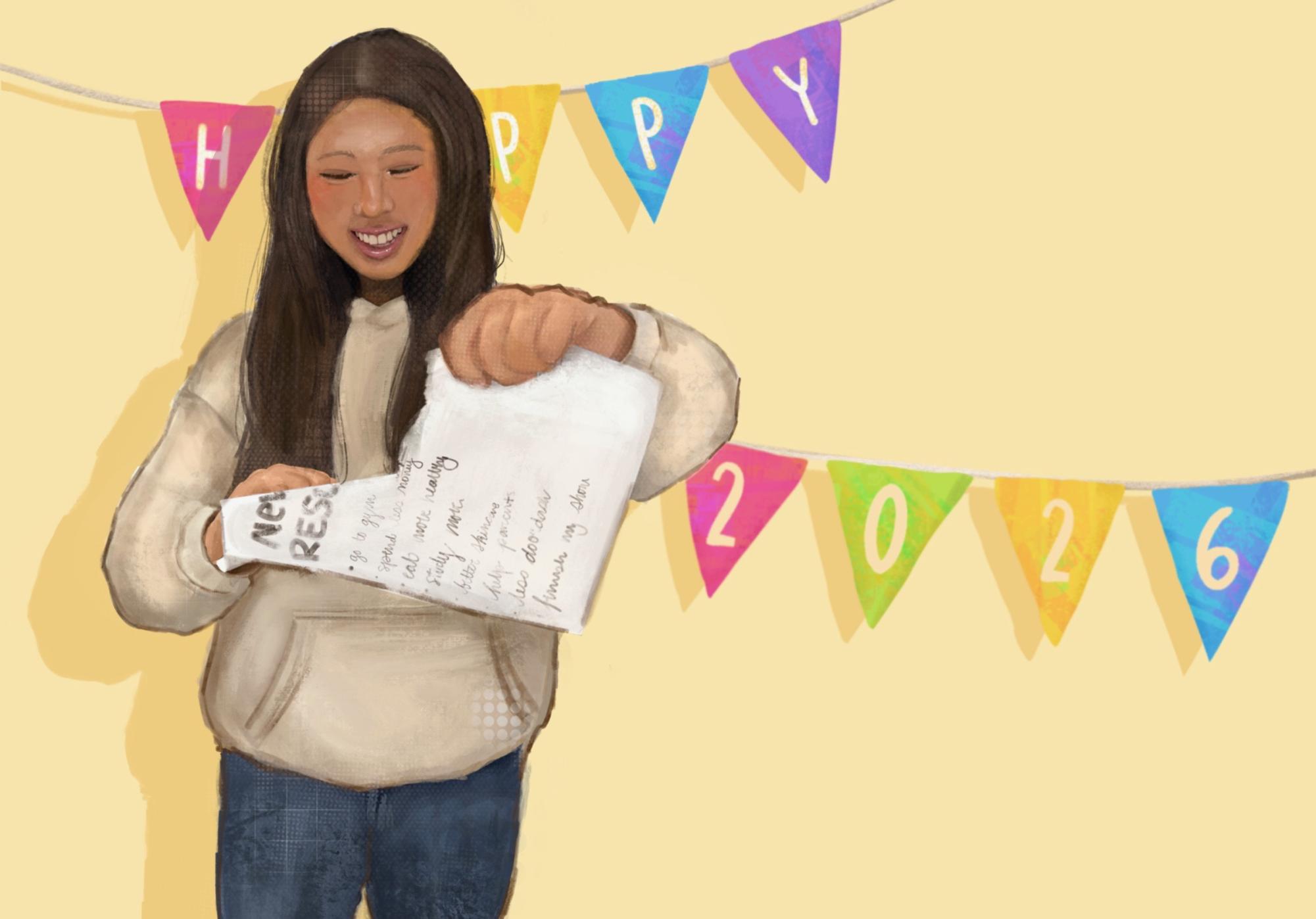

Following the cliche of honesty being the best policy, I have a confession: I haven’t made a New Year’s resolution since eighth grade.
It’s not because I don’t seek to change myself. Believe me, I think that new goals are good and necessary for human growth. But after experiencing the harsh reality of how hard it was to keep my commitments over the years, I now see that New Year’s resolutions don’t promote a fresh start. More often than not, it creates unrealistic standards and sets up a system that makes us feel like failures once we can’t reach our unattainable goals.
I didn’t always feel this way, however. I even remember the first time I made a New Year’s resolution. It was also the first time I came upon the word I’d become all too familiar with over the next few years: procrastination.
I was sitting in my fifth grade classroom, anticipating the upcoming winter break. As I daydreamed about my favorite holiday of the year and my birthday, of course, my teacher began to go around the class passing out worksheets with the words “New Year’s Resolutions” and 2019 paired together at the top. My fantasies of opening the glittering, unwrapped presents under the twinkling lights of my Christmas tree, eating warm cookies and heading to my ski trip were interrupted as my teacher began class.
“With the new year, you’re supposed to make goals to be better than last year,” she explained.
Easy, I thought to myself. I knew exactly what my goals should be.
Stop procrastinating, sleep earlier and eat healthy. Typical, generic goals that I thought were pretty easy to keep.
As I wrote down my goals on the New Year’s themed worksheet, I optimistically started dreaming of the “new version” of myself.
The concept sounded amazing to my 11-year-old self, and I could already see future Lauren: someone who got all of her work done by 6 p.m., leaving a few hours before bed at 9 p.m. to catch up on Alisha Marie’s Vlogmas series, all while eating a salad for every meal.
Yet the following week, I fell back into the same patterns. I thought keeping these goals would be so easy, but it proved harder than I imagined, leaving me frustrated at myself for my inability to succeed. I couldn’t understand why I wasn’t immediately becoming the “new me.”
The slip back into my old self wasn’t just because I failed. I also failed because, over time, I forgot.
Over the next few years, this monotonous cycle repeated: make a New Year’s resolution, forget it, break it and then set even higher expectations for myself the following year. Eventually, after facing the consistent annual disappointments, I learned that I’d rather not set any goals than face the inevitable shame year after year.
The truth is, this cycle doesn’t plague only me. According to the Baylor College of Medicine, studies show that 88% of people who set New Year’s resolutions fail to meet them within the first two weeks. That’s exactly what happened to me. I couldn’t reach these unattainable goals and failed just as fast as I had made them.
Resolutions also create a stigma where change can only happen at the start of a new year.
When a person ultimately fails to meet their New Year’s resolution, as statistics show is the case for the majority of the population, they respond in one of two ways.
One is by telling themselves they’ll wait until next year and try again.
The other is the rare minority who can pick themselves back up and try again.
More often than not, we go into the New Year hoping to reinvent the best version of ourselves. From vows to eating healthier and going to the gym more to less procrastination, we all make resolutions based on our perceived “failed” versions of our past selves.
But I believe that this mindset is the reason why so many people — myself included — fail to meet these high expectations of ourselves.
After failing the first time, I built up a wall of pressure.
Personally, when I set high expectations for myself, I end up paralyzed with fear and uncertainty about how to move forward.
The night I made my resolutions, I lay wide-awake in my fuzzy pajamas, already envisioning the “new and better version” of myself.
Before I knew it, the next night had come, and I still had piles of homework in front of me by 9 p.m. I had already broken two out of three of my objectives: don’t procrastinate and sleep early.
I realized I would have to put all of these big resolutions into action, and this is where I failed; I knew what my end goal was, but I had no means of getting there.
Soon, one day turned into two, then a week. Before I knew it, I forgot about the “new me” and complacently went on with my current habits.
The next year, I made the same three goals with identical hopes of achieving them. Yet, my expectations were not met, and the cycle began again.
I know what I want my end goal to be, so why can’t I get there?
I felt like a “failure” and contemplated why I couldn’t reach my goal.
I’ve come to realize that this isn’t because my goals were unattainable. It was the way I was approaching them.
New Year’s creates high pressure for people to reinvent themselves. We thrust ourselves into entirely new routines of going to the gym every day for two hours and sticking to a restrictive diet, convincing ourselves that kale salads are the way to go in the new year. A study from Forbes Health attributed individuals focusing on specific outcomes as one of the causes for 99% of the survey’s responders’ reasons for not sticking with their resolutions all year. This leads to burnout and failed versions of ourselves. The farther we fall, the harder it is to get back up.
That’s why people face the problem of disappointment with resolutions and fall right back into old patterns.
In all transparency, I believe the only way towards self-improvement is to work from the current version of myself, whether that’s increasing by 10-minute increments of working out or eating from home three times a week rather than every day.
Looking back, compared to the fifth-grade version of myself, the senior me now understands the realities of New Year’s resolutions. I no longer put pressure on myself to change for the new year, but to focus on the actual goal at hand.
I now set my main goal, along with the steps on how to get there. Don’t get me wrong, I still struggle with procrastination, but rather than envisioning the “new version” of myself, I see the different paths I need to take to arrive at my destination.
By breaking down my work, setting time limits for each assignment and putting my phone out of sight behind my laptop, I maximize my productivity and walk one step closer to my end goal.
It doesn’t matter if I make a goal in January or in November. Progress takes time, and the pressure of New Year’s resolutions makes none.
I tend to set high expectations for myself, and when those expectations aren’t met, I often get easily discouraged and give up. But I’ve learned that when I slowly build from the ground up, it allows me to work through these goals. In a way, these small steps act as checkpoints for me to fall back on.
The more I place emphasis on a fresh start at the new year, the less motivated I feel to make changes in June.
After learning the hard way, I just don’t think that New Year’s resolutions are for me. I believe change is important — but it shouldn’t bring stress and a sense of failure to my life. Instead of “new year, new me,” let’s normalize “new year, same me.”