
One page at a time.
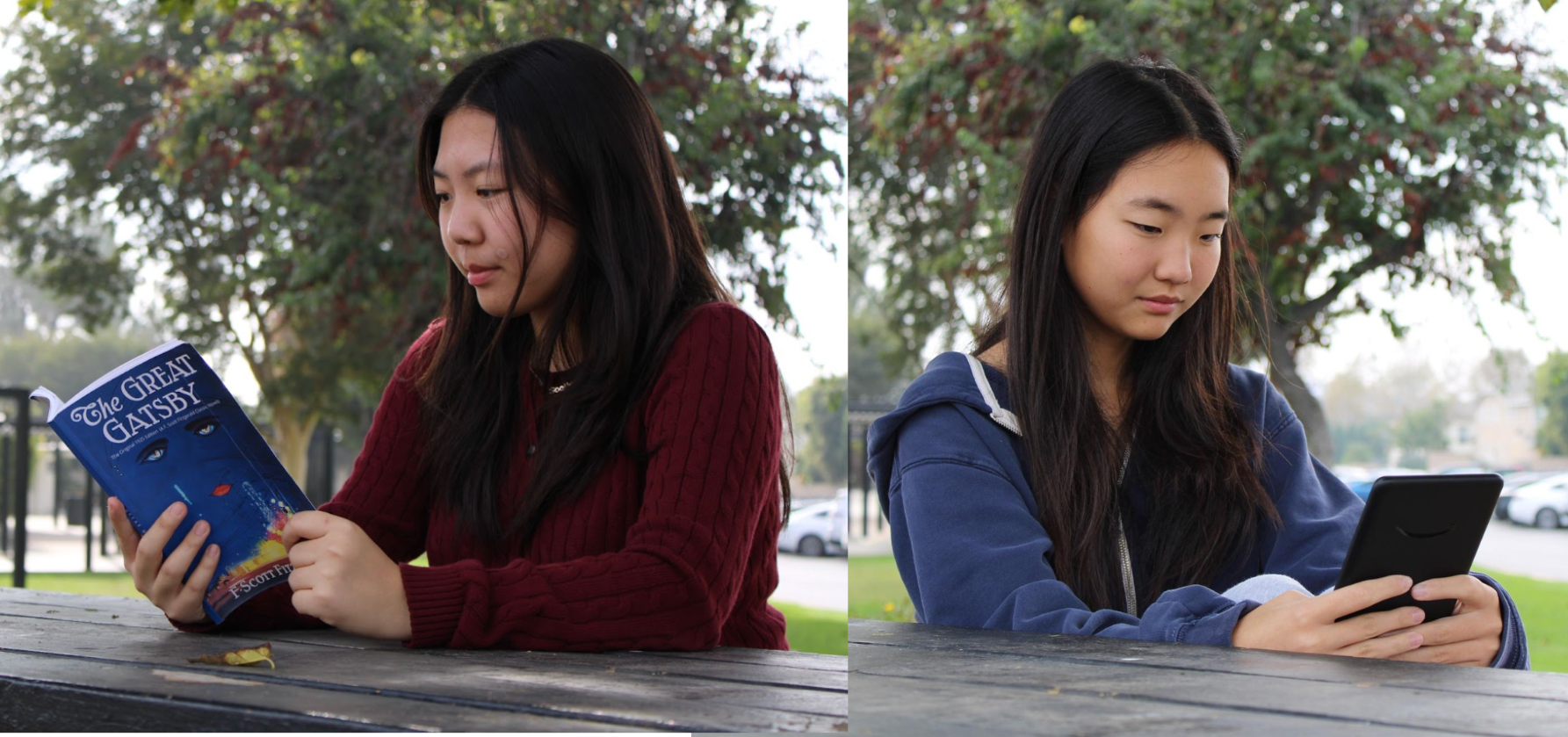
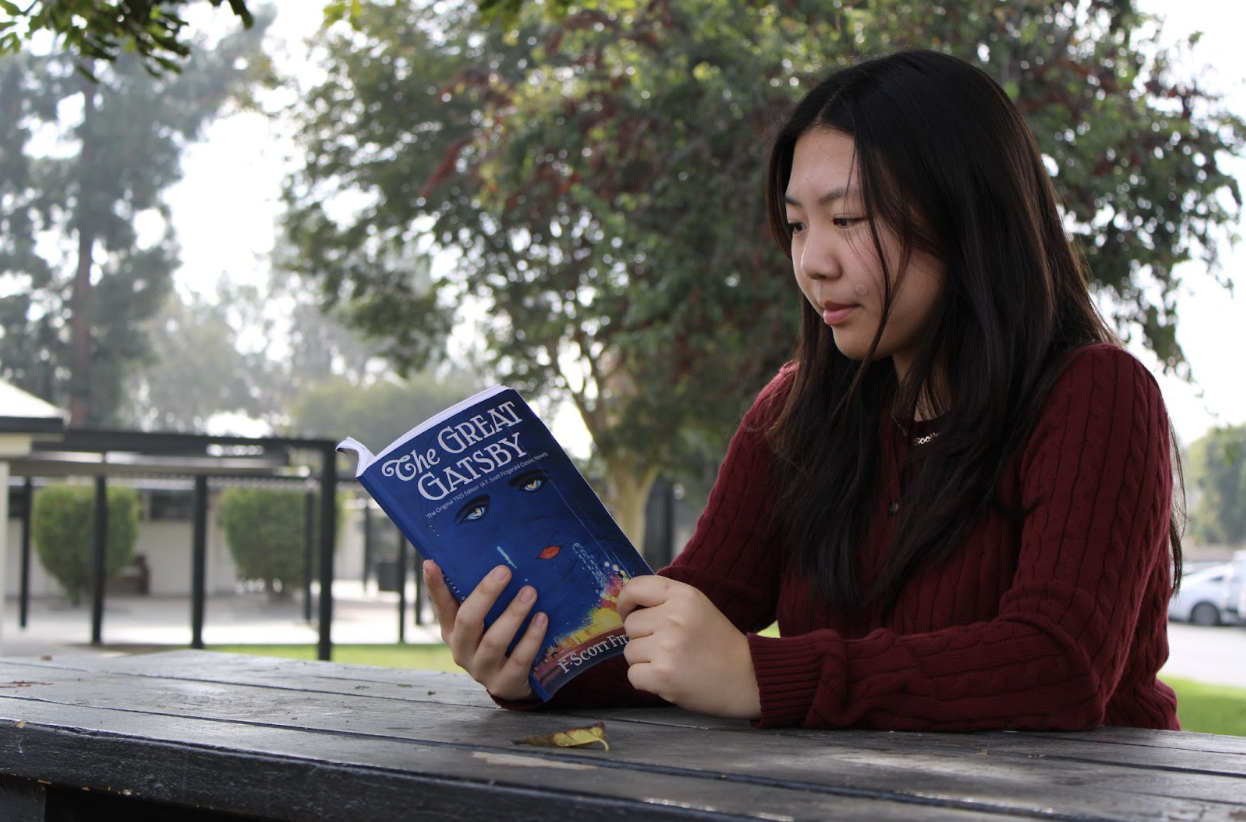
Flipping through the light matte papers, one by one, readers like myself become the absolute and undeniable beholder of their book.
Each new page, each new flip, each new line catalyzes an uncalled story — and this indispensable essence of tactile reading will never be replaced by screens. So, we should stick to traditional paperbacks and classical reading, which provide many more benefits than online reading.
Last Christmas, my mom gifted me a Kindle e-reader.
Because my friends who owned Kindles told me such good things about the newfound technology, I asked her if I could get one for the holiday as well.
In great anticipation, I set up the device and began purchasing online versions of books I wanted to read. The Great Gatsby. The Myth of Sisyphus. Crime and Punishment. Those were all books I saw online as classics I should read. Purchase by purchase, I built up my collection over time.
At first, I enjoyed it. The portability and ease of accessing books instantly provided me with temporary bliss. But after a week, I decided to put the device down. Not because I got tired of it, but because of several recurring reasons.
First, eye strain.
As I read on my Kindle, I experienced a lingering headache followed by an evident eyestrain. Because of this, I couldn’t properly focus on the book itself. I also noticed comparably lower scores when I read school materials online as opposed to the physical copy. Moreover, I caught myself rubbing my eyes six to seven times after every page loaded on the screen, and ultimately stopped using the device.
My terrible experience was explained through science.
According to a research article published by the National Center for Biotechnology Information, e-readers end up developing visual consequences such as “a high prevalence of eyestrain, headache, diminution of distance vision and eye watering.”
Unlike paper books, which took no toll on me physically, this electronic device disrupted my peace of mind while reading. And I find that comfort is the most important factor when it comes to an optimal reading environment — something the Kindle doesn’t provide.
Although I sometimes bring out the device in desperate times, I have stored it away and choose not to use it unless I absolutely must, which is rare, because I prefer a medium that prioritizes my eye health.
Not only on a Kindle, but whenever I read online texts for school, I often have to either close my eyes or my device. In a world of give-and-take, this pain would be durable if it provided any benefits, such as increased concentration or memory.
But science says no.
According to a February 2024 article by Psychology Today, in an experiment comparing the two reading mediums, participants who read on paper retained more information than those who did not. When holding the book and flipping through pages, the “object manipulation provides spatial information which is crucial for building coherent mental representations of the manipulated object.”
For this reason, while my peers changed their note-taking methods to online, I have always preferred reading and annotating on paper. Though it may be my personal preference, studying on paper definitely helped me better prepare for exams.
In my fifth-period Advanced Placement United States Government and Politics class, my teacher offers the option of taking notes online or on paper. I always opt for the latter. After all, I noticed higher test scores, which ranged from 9/10s and 10/10s, when I read and annotated on paper, as opposed to when I took notes online, which I would usually get sixes or sevens.
And who doesn’t want better concentration and memory when they’re studying? I would much rather read on paper, peacefully, rather than “flipping” (actually, swiping) through the e-pages back and forth to forcefully retain the information.
Some say paper books cost more and take up too much space, but even that itself becomes a pro.
Because beyond the whopping $100-$400 cost, these Kindle devices are susceptible to water damage.
Though I never broke my own Kindle, my sister did.
One spill, and it was over. As the water seeped into the device, fear crept into my sister’s face as she realized she had broken a device she spent hours of her life developing. Months of collecting books — gone.
Because e-books are bought under license, when another Kindle device is purchased, they can be recovered. However, that means that the user must purchase another $100-$400 device if they don’t have any warranties.
And although the books are saved on the user’s Amazon account, the device that’s supposed to provide the optimal reading experience with a paper-like feel failed its intended purpose. Because the Kindle broke, she had to read through other devices, but those emitted even more blue lights that damaged the eyes.
Unable to let go of the e-books she previously purchased, she considered buying another device, but our mom persuaded her to opt for the much safer and more affordable option: paper books.
Unlike the easily-damagable-and-breakable Kindle, physical books, despite taking up too much storage, prevent this. When you spill water over one of your multiple books, you can just replace that one book — much more cost-friendly. Moreover, through this physical collection, the book truly becomes the user’s possession, not a license.
For instance, my house has exactly five bookshelves. The biggest shelf, rimmed in brown paint, is downstairs next to our dining table. It becomes a haven of comfort and nostalgia as we eat, talk and read with one another next to that shelf. My room also has a white shelf that mostly contains academic books, ranging from textbooks to scientific literature. This small piece of furniture completes my room.
These shelves all contain tens, if not hundreds, of books. This physicality provides much coziness to our home, and the books become present, not as a license, but as a part of the Cho family. That makes our home, home.
And if the storage truly becomes a problem, donate it. That is one option you have as the one in complete possession of the book. Unlike e-books, you can donate or sell books for their worth.
We live in an age of technology, and all traditional activities are lost to electronic devices. But in this online generation, we should still keep our classical, antique selves (and shelves) at bay — books must stay preserved.
Kindle? Forget it.
Open the book in front of you and immerse yourself in the imaginative realm only paper books can provide — one free of eye strains, distractions and damage.
The world of the book is now yours.
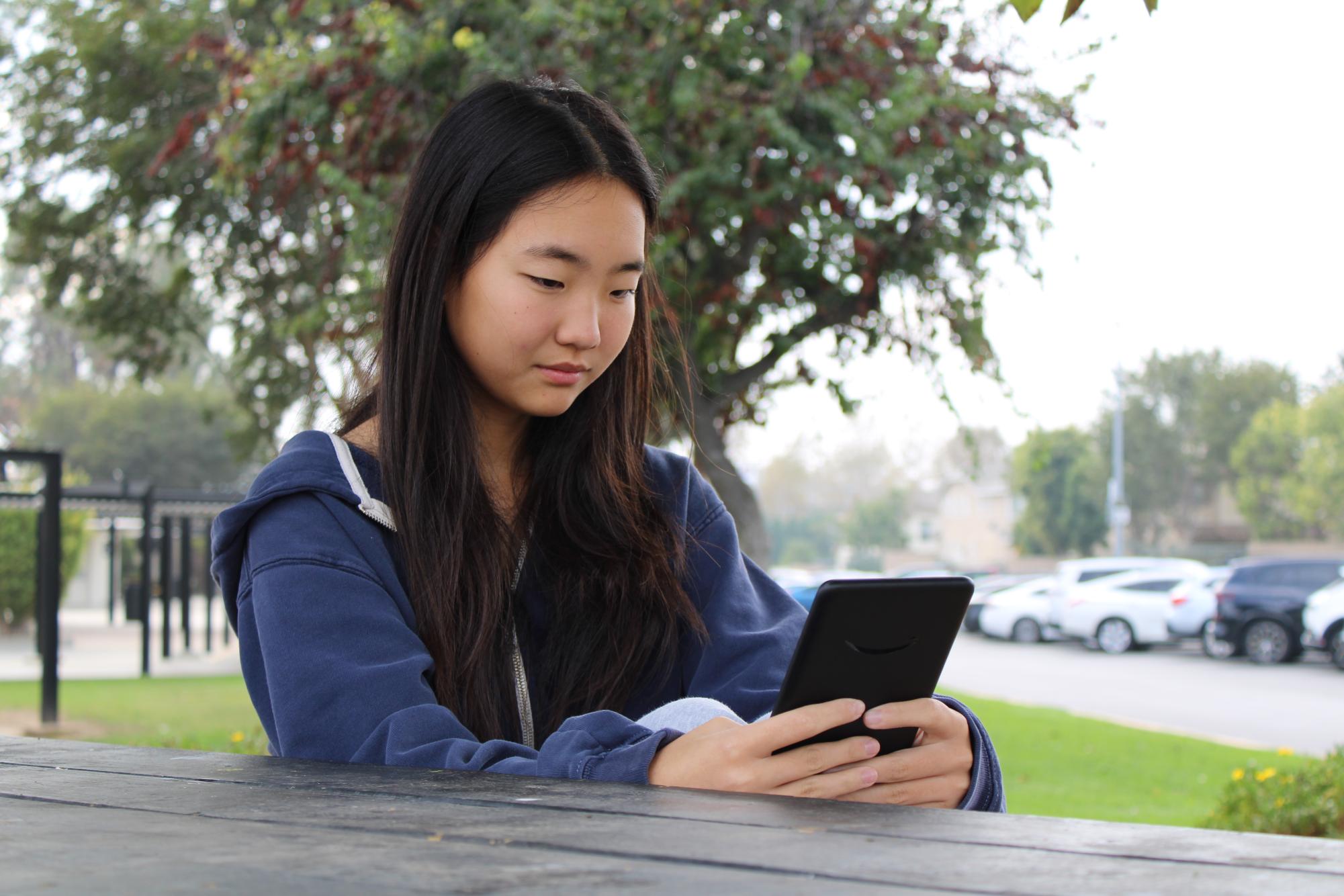

Growing up, books were my entire world.
From learning spells at Hogwarts to embarking on dangerous quests at Camp Half-Blood, every page took me somewhere new. Reading wasn’t just a hobby — it was a doorway into new worlds.
As I grew older and graduated to longer chapter books, my small, two-tiered white bookshelf quickly overflowed. Soon, books spilled onto the coffee table and stacked up in boxes in the garage, forcing me to face the truth — there simply wasn’t enough space for them all.
I was devastated. It felt as if I was abandoning an already dying pastime and leaving behind my childhood.
The summer after my sophomore year, I attended California State Summer School for Mathematics and Science [COSMOS] to study climate change.
After a long day of learning, I trudged into my dorm, and as I stuffed my backpack into the closet, I turned around to see my roommate, snuggled on her bed, holding a peculiar-looking device — too small to be an iPad but too large to be a cell phone.
It was as if fireworks had gone off in my head. There, right under my nose, was my solution: a Kindle.
I spent hours during my free time researching the various literary treasures this screen had to offer. With every YouTube review video and blog post I read, I was captivated by the sheer idea of having a library in my hands.
I’ve always loved the feel of physical books — the crisp pages, the weight in my hands, even the rustles when I turn a page. However, when I think about sustainability and space, e-readers are much more progressive.
Over the course of the four-week summer program, I spent a considerable amount of time debating whether or not this investment was worthwhile. I even created a spreadsheet comparing different Kindle models. The chart, divided into three color-coded sections, compared the costs, selection of books and the offered physical features of the devices.
After a cross-examination of the Kindle, Kindle Paperwhite and Kindle Signature Edition, I eventually narrowed it down to the Kindle 16GB and Kindle Paperwhite; the Kindle Signature Edition was eliminated for its hefty cost.
Ultimately, it was my indifference to warm light and screen size that led to my decision to purchase the Kindle 16GB. From the moment I held the Amazon package in my hands, I knew it would change the way I read forever.
On Amazon, the Kindle is listed to cost $109.99, the Kindle Paperwhite at $159.99 and the Kindle Signature Edition at $199.99.
With traditional book costs ranging between $10-$20 for paperbacks and $20-$35 for hardcovers, according to ebookwritingexperts.com, the initial cost of a Kindle is equivalent to roughly seven to 12 paperbacks or four to seven hardcover novels.
As a frequent visitor to the Barnes & Noble at Amerige Heights Town Center, I always fell victim to the buy-one-get-one-50%-off tables. What was supposed to be a quick browse almost always ended with me carrying two to four new books to the checkout counter.
With my monthly allowance already suffering from these impulse buys, the possibility that an e-reader might spare both my wallet and my bookshelf was quite appealing.
At a given time, Amazon offers readers 60,000-80,000 free titles. For Amazon Prime members, the Kindle offers an Amazon First Reads Program, which provides free early access to unreleased books, and Prime Reading, a rotating selection of 3,000 books.
With the optional Kindle Unlimited program, which costs $11.99 a month, readers can have an additional 5 million titles to choose from.
Do the math; it’s a win-win scenario. According to the Pew Research Center, an average American reads a mere 12 books each year.
This means typical readers will compensate for the cost of their e-reader in one year, and individuals with the Kindle Unlimited subscription — for the mere cost of a single paperback novel per month — will have access to millions of books, proving this mode of reading is significantly more cost-effective than its physical alternative.
As someone who regularly goes on reading binges — at times reading four to five books a month — investing in a Kindle has considerably lowered my monthly spending.
I’ve also taken full advantage of my e-reader’s extensive offerings. Whenever I get a Kindle notification about new First Reads selections or updates in the Prime Reading lineup, I immediately reach for my device.
One of my favorite discoveries was the mystery novel “Strange Pictures” by Uketsu, which I discovered on my weekly Kindle doomscrolls. Free from the worry of price tags, I felt so much more encouraged to read genres I’ve never touched before.
Additionally, with less concerns on the costs, I felt so much more motivated to read. The extensive collection also gave me the liberty to discover new authors with every tap.
From having to rely on trips to Barnes & Noble and scrolling through Amazon, this transition has given me the freedom to take my time, borrow as many books as I want, and browse endless options before reading.
While applications such as Libby, a mobile and web app for borrowing e-books from your local library, and digital libraries such as Project Gutenberg, provide free access to thousands of books on your mobile devices, they have their own limitations.
I have used Libby since the start of middle school, and as much as I loved the app, due to the limited number of digital book copies, I sometimes experienced incredibly long wait times to borrow a book.
I had attempted to reread “The Maze Runner” on my school-issued iPad during my free time; however, the stipulations were absurd.
Day after day, I would open the app, only to be disappointed with the words that would flash across my screen: “You are sixth in line (started eigth).”
My impatience got the better of me, and I distanced myself from the book and, eventually, the app itself.
Additionally, as someone who almost exclusively reads at night, the daily flash bombs from reading on my iPhone and MacBook left my eyes strained after long reading sessions.
The portability of these devices further assures their superiority over physical books.
While driving to Huntington Beach with my parents, I loved how easy it was to just pull out my Kindle. When traffic slowed on the highway, all I had to do was reach into my tote bag, slip out the thin device and click it on — no scrambling for Wi-Fi, and no heavy hardback weighing down my lap.
By the time we arrived at our destination, I had already breezed through multiple chapters without even realizing how much time had passed.
With options to adjust screen brightness among all models and light warmth in Paperwhites, these devices are easier on the eyes than blue light.
Of course, critics of e-readers often argue that nothing will ever replace the experience of reading a physical book, and to some extent, I agree. There is a certain nostalgia in reading print books; however, I find the most important purpose of reading to be the content of the story.
Whether on paper or screen, this feature remains the same.
E-readers have also helped me grow as a reader.
When I stumble across a word I don’t know, one tap brings up the definition instantly, letting me stay immersed in the story. My highlights and notes also sync across my devices, so I’m able to revisit them on my laptop or cell phone whenever I need.
These small interactions have helped me pay closer attention, and I find myself engaging with the text in a way I rarely did with physical books.
At the end of the day, I will always have a soft spot for physical books; they have shaped my childhood. However, nothing will beat the freedom and ease e-readers give me.
Your donation will support the student journalists of Sunny Hills High School. Your contribution will allow us to purchase equipment and cover our annual website hosting costs.