![A student waits as an artificial intelligence [AI] chatbot generates a response. This captures the growing allure of AI as a source of quick answers, emotional support and creative tools.](https://shhsaccolade.com/wp-content/uploads/2026/02/19B3B811-8876-4382-95B2-F36232AC40A2.png)

“Loading response…”
A student taps the submit key, sets their phone down and waits as a chatbot processes a question. The screen pauses, then fills with text.
This scenario has become a familiar sight to many students seeking homework help, social media captions and even emotional support.
Over the past few years, artificial intelligence [AI] models like ChatGPT, Gemini, DeepSeek and Claude have become commonplace as they expand across various fields, including education, entertainment, health, art and science.
“I use AI a couple of times every week for random stuff,” senior Cassius Hong said. “For example, I haven’t really used it for school, but I have used it to track my calories.”
According to a Dec. 19 article from Econofact, AI has been a long-term goal for computer scientists, and its recent momentum comes from various factors.
This surge can be attributed to AI-related hardware, software and economic impacts, as well as the free access given to the general public.
That instant response, along with the ease of use, helps explain the allure of AI, captivating users with the promise of conversations, quick answers and free entertainment.
“After years of slow progress, AI’s use has exploded since November 2022 with the introduction of user-friendly interactive chatbots developed from sophisticated statistical analysis of large data sets,” the report said.
FROM SEARCHING TO SHARING
As AI tools have become easier to access, students are not only using them for productivity but also for personal purposes, such as for private questions or emotional support.
A July 16 nationwide survey from Common Sense Media found that about 72% of American teenagers have used AI companion chatbots at least once, and around one-third have interacted with these tools for social interaction or emotional support rather than just entertainment or homework.
For some teens, that constant availability adds to AI’s allure, offering a space that feels private, responsive and always ready for conversation.
“AI companions are emerging at a time when kids and teens have never felt more alone,” founder of Common Sense Media James P. Steyer said. “This isn’t just about a new technology — it’s about a generation that’s replacing human connection with machines, outsourcing empathy to algorithms and sharing intimate details with companies that don’t have kids’ best interests at heart.”
According to the article, experts caution that while AI can provide general information, it is not a substitute for professional medical or mental health care.
Mental health specialist for Sunny Hills students Staci Balliet shares that sentiment and said she advocates for professional human services.
“I believe that there can be a lot of risk with the use of AI, as conversations surrounding mental health and seeking help require a high level of empathy and compassion that a computer cannot give,” Balliet said. “A lot of the interventions used to improve mental health conditions require a relationship, connection and rapport with the therapist [or] provider.”
Most public-use AI chatbots are not designed or approved as medical devices and cannot evaluate individual health needs or provide diagnoses.
“I believe the internet has provided a great opportunity for awareness, prevention and conversation surrounding mental health, maybe opening the door for students that might otherwise be shut… but, seeking therapy or emotional support through AI has too many potential risks that outweigh the benefits,” she said. “There needs to be a certain level of expertise to handle mental health crises that could be life or death for some people.”
Some students said they turn to AI for a new experience.
“I talked to Gemini before about how my day was going,” freshman Kyle Leem said. “You know, I was having a really bad day, and I didn’t have anybody to talk to, so I decided to pull up Gemini real quick and start talking to it.”
Junior Megan Al-Rawi had a similar experience but had a different conclusion.
“I have used it as a conversation partner before, but I stopped when I found it more isolating than helping,” she said. “[I tried it because] I was just at home a lot of the time during the summer and all my friends were out of town.
The sense of accessibility and anonymity can make AI appealing, even when students recognize its limits.
As students grow more comfortable using AI for academic and personal questions, guidance is a key component in balancing its usefulness with help from trusted adults or trained providers.
INSIDE THE CLASSROOM
With AI becoming more established across different aspects of students’ everyday lives, social science teacher Hera Kwon said its growing presence has begun to influence how students approach schoolwork.
“I noticed it when students would turn in projects, and they were basically ‘perfect’ or made no sense,” Kwon said. “While shortcuts may be necessary, I am worried about what we might be missing or losing by only taking the shortest route.”
Some students acknowledge that shift as well and agree that AI has become a routine part of their lives.
“I use it every day to do my homework and to do research,” freshman Aiden Kim said. “I use it mainly as a time-saving tool because of the amount of homework I get these days.”
For many students, AI’s allure stems from its ability to provide quick support, adding to its appeal as a study tool.
Junior Maya Orten said she also uses AI for educational purposes and treats it as a personal tutor.
“I just use AI to help me study for tests by asking it to make me study questions or [Quizlet-style] things and to create new questions, especially for math,” Orten said. “If I don’t understand how to do something, I ask it to help me in depth.”
However, while many students view AI as a useful tool, teachers have a differing opinion of its presence in the classroom.
“I don’t understand enough about [large language models] to open it up for widespread student-use,” said Kwon, who said she remains undecided. “While I have suggested some AI tools to help students as a study tool for test prep, I do not see a place for it as an integrated part of my classroom.”
English teacher Thomas Butler compares AI to previous technological shifts, such as spellcheckers or online databases, and said that people, not technology, influence its impact.
“[AI has] the same trends I saw when Wikipedia came along, and Sparknotes and Course Hero,” Butler said. “Students who are looking for a shortcut lean heavily on technology [far] more than they should [while] others use them as just another tool to have in the toolbox.”
Moreover, several educators said that the popularity of AI questions the integrity and standard of student work.
“My concern is that students are using AI to think for them, and it gets to a point quickly where the students now no longer think for themselves, nor want to think for themselves, and automatically return to AI instantly,” English teacher Jennifer Kim said. “Now I would think that in the real-world work situation, they’re using AI all the time, but those are adults whose brains have already fully formed.”
To educators, the features that make AI attractive also make it difficult for students to step away from it.
Kim said adults have already developed their brains, so using AI may not affect them as much, but for teens, AI can act as a shortcut and prevent the brain from developing, similar to how muscles only grow through weight lifting and regular use.
Teachers said that sudden shifts in grammar and tone from students pushed them to find solutions for checking originality and academic integrity.
“Instead of accusing anybody, I let the kids know ‘Hey, this has come back as AI for quite a few of you guys [and] I’m going to give you a chance to admit to me if you did it or not, and if you did, I’m going to give you a chance this time,’” Kim said. “All of the kids that Turnitin said used AI admitted to [it], and then there were some who used AI that admitted to it but didn’t come up on [Turnitin].”
The growing allure of AI has pushed schools to adapt to keep up with how students use the technology, such as implementing AI-recognition platforms to help determine if submitted work was genuine.
One tool that is commonly used is Turnitin, an internet software that was previously used for plagiarism detection and now includes AI observation features.
However, the reliability of such tools has been questioned with concerns over false accusations.
“AI detectors are about as reliable as any AI, which is what they are, and they have the same issues,” Butler said. “They can be useful, but are not infallible.”
According to the University of San Diego Legal Research Center, AI detectors were reported to have a false positive rate of 50% and a false negative rate of approximately 80% to 90%.
“Multiple studies have shown that AI detectors were neither accurate nor reliable, producing a high number of both false positives and false negatives,” the paper said. “There’s no silver bullet to solve the problems AI generated text poses.
“Quite likely, there won’t ever be.”
ART OR ALGORITHM?
Beyond academics, AI has also grown in entertainment and social media. AI generated memes, images, videos and games circulate online, accelerating the speed at which new content is created.
Much of AI’s appeal in entertainment comes from how easily it allows people to create. With just a short written prompt, users can generate images, music or videos that would normally take hours or days of effort to create.
“AI videos are a way to get more creative with things, and it saves a lot of time and helps people generate a lot of money without doing anything,” Leem said.
Phrases such as “generating” and “this content may be AI generated” commonly appear across platforms powered by generative AI models developed by companies including OpenAI, Google, Anthropic, xAI and High-Flyer.
Some examples of platforms that utilize AI are X, Instagram, TikTok, Spotify and Discord.
In an Oct. 2 article by BusinessWire, it explains that for many users, the allure of AI in entertainment is not just the content itself, but the control AI gives as it allows for anyone to experiment, create and share ideas without needing advanced skills.
“AI-powered tools are able to shave off production time and expenses without sacrificing quality, allowing creators to scale content more quickly,” the article said. “With increasing demand for short-form and high-volume content, AI-powered automation provides a vital edge for studios, influencers, and content platforms.”
Within those platforms, AI generated art, music and voice replication have also gained controversy, raising questions about its originality.
“I feel like art has emotions and contains someone’s stories, while AI doesn’t have emotions or stories,” senior Jimin Kim said. “It’s just faking.”
Still, the ease and speed behind generative AI continue to draw people in. The ability to produce something new in seconds gives AI its strong appeal, explaining the increase of AI generated content in the Internet.
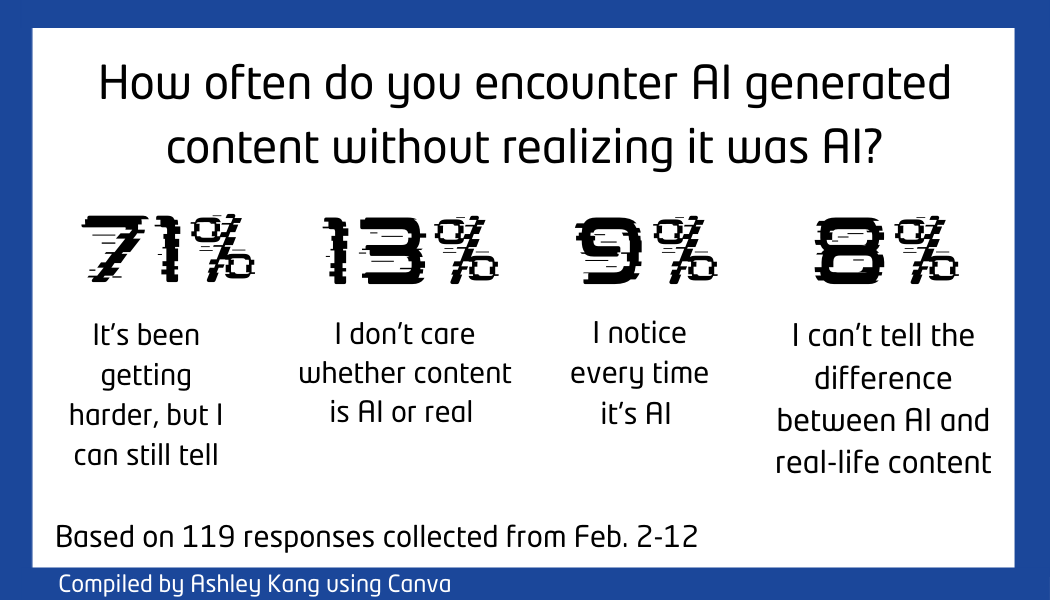
Not only is there more AI-created media, but it is also becoming harder to tell when content is AI generated as its quality is rising. According to a poll conducted by The Accolade, 82 out of 117 voters said that, although it’s getting harder, they can still tell if something is AI-created content.
“Sometimes I notice that it’s AI, and for me, I think that content has generally become more fun and entertaining to my eyes,” Leem said.
Real-world debates over the ethics of generative AI have extended past online media.
In November 2025, the Downtown Bozeman Association in Montana faced significant controversy during its annual art contest after the winning design was accused of being created with AI.
Incidents like this highlight that debates over AI ethics are no longer hypothetical, but increasingly relevant to everyday lives.
As AI continues to load responses in seconds, the challenge for schools may not be stopping its growth, but teaching students how to navigate it responsibly. Whether artificial intelligence becomes a learning aid or a dependency may ultimately depend on how today’s students choose to use it.